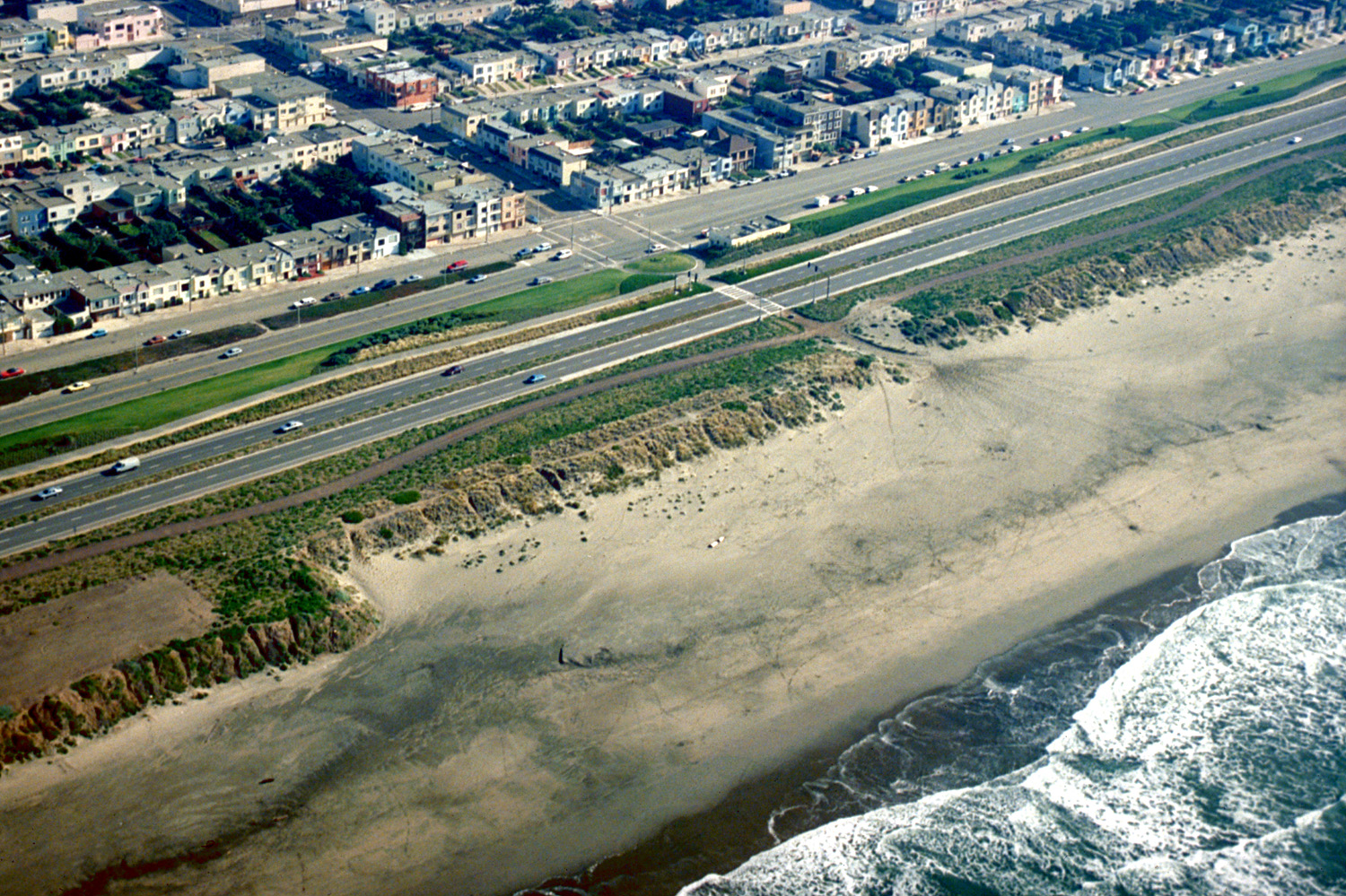
A $175 million seawall approved by the California Coastal Commission in 2024 would protect a sewage plant from the eroding surf — but four researchers preparing to publish a paper say it could leave San Francisco with a concrete barrier and no beach behind it.
The sewage treatment plant that processes 12.5 million gallons of San Francisco's wastewater every day sits just inland from the south end of Ocean Beach, close enough that on a winter high tide, the waves get uncomfortably close to the pipes beneath. Stand at Sloat Boulevard where the sand thins and the problem is legible: the beach is smaller here than it was a generation ago, and the infrastructure that depends on the ground staying put is right there.
That geometry is the backdrop for a coastal puzzle that has occupied researchers for decades, and a $175 million proposed solution that some of those same researchers warn could make things worse.
Since at least the 1980s, sand has been accumulating at Ocean Beach's north end while the south has been steadily losing it. Coastal engineer Bob Battalio, who has studied and surfed the break since the '80s, told the SF Standard this past weekend that the north end is now roughly 800 feet wide in places — a stretch where, in the 1970s, surfers entered the water directly from seawall steps that today are buried under feet of sand. Battalio argues that the Army Corps of Engineers' deepening of the nearby shipping channel in that same decade displaced a large volume of sediment northward, where it accumulated and stayed.
Patrick Barnard, a former U.S. Geological Survey researcher now at UC Santa Cruz who spent two decades studying the San Francisco shoreline, points upstream as well: dams trapping sediment, tidal marshes filled for development, years of sand extraction from the bay floor. "Something like 25 million dump trucks of sediment were extracted from San Francisco Bay historically," he told the Standard. "It's definitely not any one thing." The precise cause of the north-south split remains disputed.
The city's answer is a seawall: 3,200 feet long — nine football fields — buried 55 feet deep along the south end of the beach. The California Coastal Commission approved the $175 million project in 2024, with construction slated to start in late 2027. It would shield the wastewater infrastructure from wave damage, preventing what the city describes as a potential sewage rupture into the surf.
But four researchers — including Chase Davenport, an Outer Sunset surfer and founder of the nonprofit Ocean Beach Institute — are preparing to publish a paper arguing that the seawall leaves the city with no clean exits. Either it funds sand replenishment indefinitely to keep the beach from eroding behind the concrete, or it doesn't and the beach disappears. Their paper contends that existing hardening at the south end — road, landfill, large rocks already placed there — is itself a primary driver of the erosion the wall is meant to contain, not a separate problem.
"I'm sure we'll go down a geoengineering path over the next 50 years, trying to keep our rigid coastlines," Davenport told the Standard. "But over time, we need to accept that we can't control a force like the Pacific Ocean."
A 2012 plan developed by urban think tank SPUR, in partnership with Battalio, Barnard, and local stakeholders, had proposed a smaller buried seawall plus dune restoration — a lighter intervention projected to cost around $350 million. The Coastal Commission went bigger in 2024.
Walk south from the Cliff House toward Sloat on any clear afternoon and the split is already visible: wide, dune-backed sand at the north end, and a progressively thinning beach to the south where the sand gives way to rock and riprap. Whatever goes in the ground in late 2027 will define what that corner looks like for a long time after.
The Discussion
Loading…