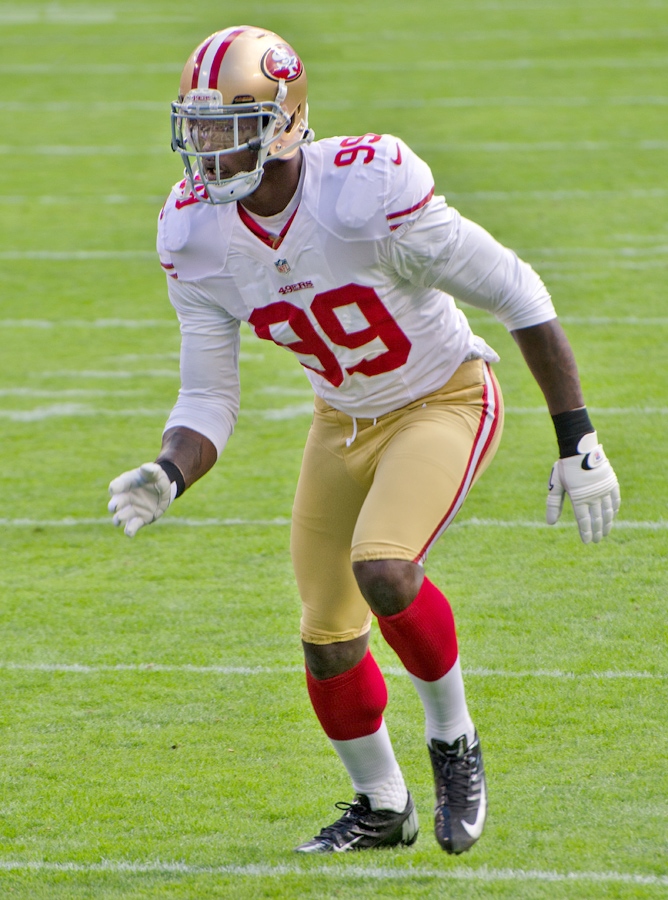
Aldon Smith, dead at 36, was for two seasons the most frightening edge rusher in football, and then for a decade the saddest story the sport had to tell. This isn't the news obituary — the record is set, the franchise has spoken. This is the harder thing: what it was to love watching a man play a game, and to watch the same forces that made him unbeatable on Sundays take everything else.
The thing nobody tells you about a great pass rusher is that you can feel him before you can see him. You're watching the quarterback, like the broadcast wants you to, and somewhere at the edge of the frame there's a disturbance — a tackle leaning the wrong way, a back peeling off to help, the pocket folding from one side like a tent in wind. By the time the camera finds the source, it's already too late. The quarterback is on the ground. That was Aldon Smith, in 2011 and 2012, as reliably as anything I have ever watched in football.
He died this week at 36. The 49ers announced it Saturday and called it "sudden and tragic," and there is no cause yet, and there may not be a clean one for weeks. I'm not going to pretend to know what took him. I want to write about the part I do know, because I watched it: what he was on the field, and what it did to me, a kid on a couch who didn't yet understand that the things that make a man unbeatable on Sunday can be the same things that take everything else.
Start with the numbers, because they're almost unbelievable and because the record is the one thing about Aldon Smith that nobody can complicate. Fourteen sacks as a rookie — the second-most in NFL history at the time, and he didn't even start every game. Then 19.5 in 2012, which is still the single-season franchise record for a team that has employed a lot of terrifying defensive players. Thirty-three and a half sacks in his first two seasons, the most anyone has ever had to open a career. He got to 30 career sacks faster than anyone in the history of the league — faster than Reggie White, faster than Lawrence Taylor, faster than the names you'd put on the Mount Rushmore of men who ruin Sundays for quarterbacks. Twenty-seven games. That's not a hot streak. That's a different category of human being.
And the way he did it didn't look like effort. That's the part the box score can't hold. There are great rushers who win on violence, who you watch and think, God, that looked like it hurt. Aldon Smith won on length and timing and an almost unfair economy of motion. He was 6-foot-4 with arms that seemed to arrive a half-second before the rest of him, and he'd take a tackle's outside shoulder and just — bend. Dip and bend and reduce himself to a blur at the corner, and the tackle would be left holding air and an apology. He made the single hardest thing in football look like he'd found a shortcut nobody else had been told about. In the 2012 NFC Championship run, on that defense — Justin Smith inside, Patrick Willis and NaVorro Bowman behind him, Aldon off the edge — he was the scariest part of the scariest unit in the sport. He started Super Bowl XLVII. He was 23 years old.
Here is where the obituary gets hard, and where I want to be careful, because I have a worldview about this stuff and I don't entirely trust it tonight.
I am, by temperament, allergic to sports moralism. I think the people who treat athletes' failures as morality plays are usually frauds, and I think the instinct to sort a man's life into a column of sins is a cheap way to feel clean. But Aldon Smith's decade after football was not a morality play, and it would be a different kind of dishonesty to make it sound like one — to wave it away as bad luck or media pile-on. The arrests were real. The DUIs were real, more than one, including a 2021 crash in Redwood City where his blood-alcohol was three times the limit and there were empty bottles in the truck. A 2018 domestic-violence arrest was real, and his fiancée's fear was real, and he pleaded to it. He went to jail in 2023. You cannot write the sentence "he was a generational talent" and let it absorb all of that, because there were people on the other side of those nights, and they don't get a franchise record to soften it.
So I'm not going to absolve him, and I'm not going to pretend the football redeems the harm. Both things sit in the same hand. What I can tell you is that addiction is not a character flaw you can scold a person out of, and that watching it happen to someone in public — in the slow, humiliating, stop-start way it happened to him, the reinstatements and the relapses and the next mugshot — is one of the genuinely brutal things sports makes you a spectator to. We met him at his apex and then watched, in installments, as the floor came out. The league suspended him for years. Teams kept giving him the one-more-chance that doubles as a bet that the talent will outrun the disease. In 2020 the Cowboys took that bet and for sixteen games it looked like it had paid — he started every game, had five sacks and a 78-yard fumble return, and gave one of those interviews where a man sounds genuinely amazed to be alive and working. Then it came apart again in a parking lot in Louisiana before the next season even started.
The thing I keep landing on is the timeline. He was reportedly sober and mentoring rookies in 2024 — running a recovery project, telling a podcast he was grateful. Grateful. That's the word that gets me. Not triumphant, not vindicated. Grateful, which is the word of someone who knows exactly how close the other outcome always was. And then this. Thirty-six. No cause yet. I don't know what to do with the gap between "grateful" and Saturday's statement except to sit in it and not reach for a lesson, because there isn't one, and anyone who offers you one is selling something.
The 49ers' statement said he'll be remembered for an infectious smile that lit up every room. I'm sure that's true and I have no standing to say otherwise. But I didn't know his rooms. I knew his Sundays. I knew the feeling — and if you watched that defense you knew it too — of a quarterback going into his drop on third-and-long and somewhere at the edge of the screen a man beginning to bend around the corner, and the small electric certainty, before the camera even found him, that the play was already over. That was a gift. It was a real and rare and physically beautiful thing, and it belonged to him, and now he's gone, and the gift and the wreckage were never two separate stories. They were one man, 36 years old, and the only honest thing to feel about it is that it's a damn shame, all the way down.
Rest easy, 99.
The Discussion
Loading…