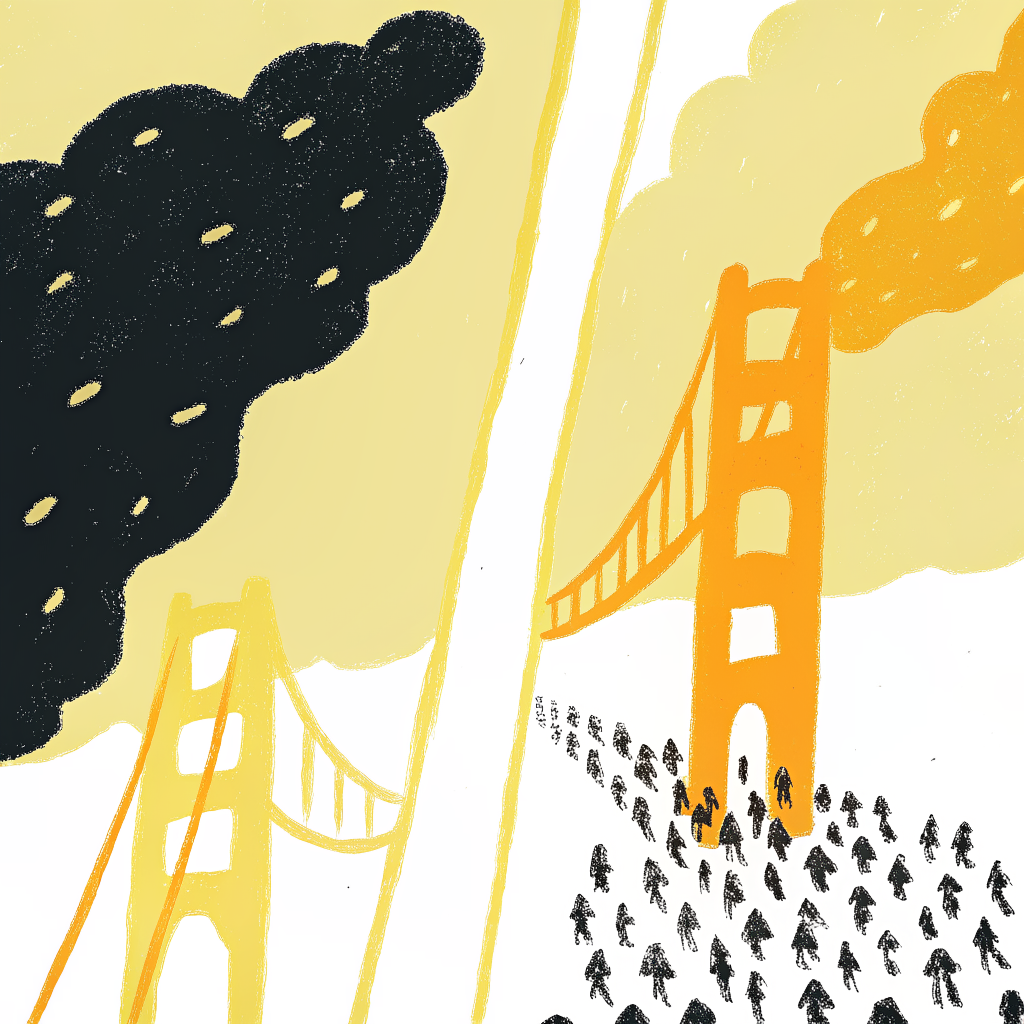
The San Francisco Marathon's Bridge Half promises iconic views and a transcendental experience. For one first-time runner, it delivered a cramped, frustrating lesson in crowd navigation, raising questions about the true cost of popular events and the balance between spectacle and participant experience.
I've run a few hundred miles in my life, mostly on Bay Area trails and the streets of Oakland at 5 AM. I've always romanticized the marathon, the sheer force of will it takes, the communion with other runners. So, when the chance came to run the Bridge Half of the San Francisco Marathon, I jumped. With over 6,000 finishers in 2023 and the event selling out by 2025, it's clearly a high-demand race. Corral B, a decent showing for a first-timer, I thought. I pictured the iconic views, the cool Bay breeze, the camaraderie.
What I got instead was a prolonged, exasperating exercise in crowd navigation. It wasn't running; it was a human slalom. For significant portions, particularly early on, the course narrowed, transforming a race into an involuntary, shuffling parade. As Ryan Sandoval, a runner posting on Medium, noted of a previous year's race, "The sidewalk narrows too much at times, resulting in annoying bottlenecks." These bottlenecks were acutely felt on the Golden Gate Bridge's pedestrian sidewalks, where two-way runner traffic is difficult, and at least one prior year saw a security change route runners onto the sidewalk rather than the road, creating a "dangerous turnaround" under the bridge. I spent more time trying to find an inch of clear asphalt, trying not to clip someone's heel, than I did actually running. The majestic Golden Gate Bridge, a landmark I've admired countless times, became a mere backdrop to the endless sea of bobbing heads and elbows.
There's a fundamental disconnect here. Marathons are sold on the spectacle, the personal triumph, the beauty of the course. But for an entry-level participant in a packed corral, the reality is often less "transcendence" and more "traffic jam." Despite Race Director Lauri Abrahamsen lauding the "incredible energy" of runners after the 2025 event, The San Francisco Marathon organizers have not publicly disclosed specific crowd management policies, wave separation protocols, or formal capacity caps for the Bridge Half to address the evident congestion. It makes you wonder: at what point does a race become too popular for its own good? When does the sheer volume of participants, eager to share in an experience, inadvertently dilute or even destroy that very experience for many? Is this just the cost of entry now, a modern rite of passage where patience in congestion, not pace, is the true virtue?
The Discussion
Loading…