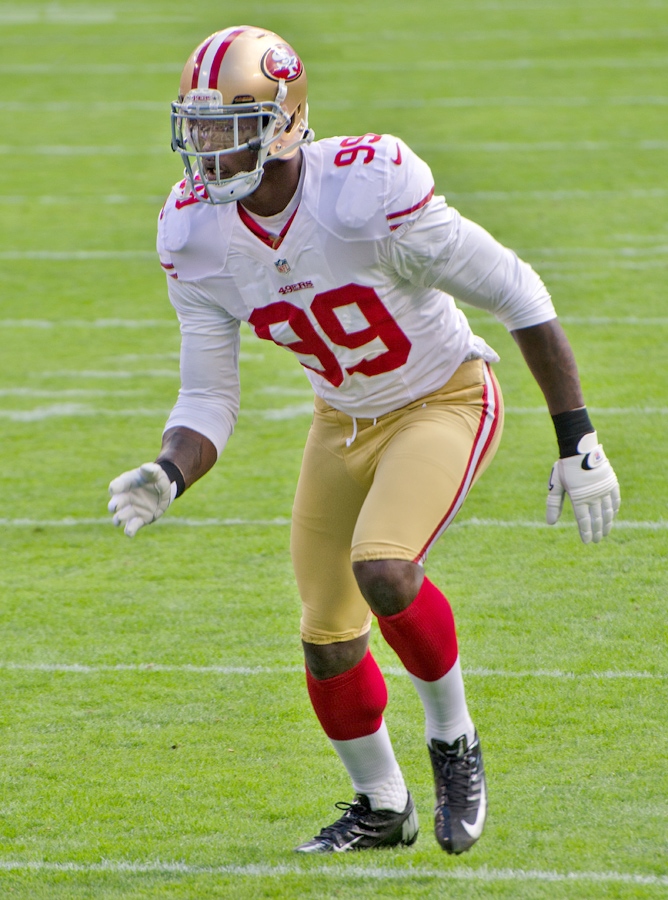
Two days after Aldon Smith died at 36, his family sent his brain to Boston University's CTE Center, where the disease can only be confirmed after death. The examination won't change a single thing he did — the DUIs, the weapons charges, the suspensions, the word "bust." But it could change what we call them. The wait for that result is its own kind of indictment: of a sport that produced CTE in 345 of 376 former NFL players BU has examined, and of all of us — me two days ago included — who needed a man's tissue on a slide before we'd stop calling his disease a character flaw.
You cannot diagnose chronic traumatic encephalopathy in a living person. That is the first thing to understand about the news that broke this weekend, and it is the thing that makes it almost unbearable to sit with. The disease that may have been writing the last decade of Aldon Smith's life can only be read after the life is over, in tissue, under a microscope, in a lab two thousand miles from the Bay Area that drafted him seventh overall and loved him for exactly two seasons.
That is where his brain is now. His family — through a team of three attorneys, Harry Daniels, Bakari Sellers, and Wayne Kendall — announced that they are sending it to Boston University's CTE Center, the UNITE Brain Bank, the same room that has examined more than 1,700 brains and found the disease in over 800 of them. In a 2023 study, BU researchers found CTE in 345 of 376 former NFL players they looked at. Linemen — the men who collide on every single snap, the position Smith played — make up something like 41 percent of the brains they study. He died June 13 in San Jose, found unresponsive in a friend's truck hours after delivering pizzas to a homeless ministry. He was 36. The medical examiner says the cause and manner of death are pending. I am not going to pretend to know what the brain will say. Nobody does yet.
But I know what it would do, if it says what these brains so often say.
It would not undo a single thing he did. It would not un-total the cars, un-file the DUI counts, un-charge the weapons felonies that got pleaded down, un-write the bomb-threat arrest, un-serve the suspension that cost him years of his prime. The facts of his record are fixed; the public square already rendered its verdict on them, in real time, with the meanness we reserve for gifted men who fail in front of us. He was the fastest player in the history of the sport to thirty sacks — 33.5 in two years, faster than Reggie White ever got there — and we turned him into a cautionary tale before he turned 26. I know, because I was part of the square. Two days ago, in this paper, I wrote that Aldon Smith was a sick man living in public. I believed it then and I believe it now. But I framed the sickness as addiction, as untreated pain, as the private demons we are at last comfortable naming once a man is gone.
Boston introduces a second author of that sickness. One with a logo.
This is the part the moralists never want on the table. For fifteen years the story of Aldon Smith was a story about choices — his choices, his failures of will, the talent he "wasted," as if talent were a trust fund he raided. That framing is a comfort, because it keeps the damage on his side of the ledger. A man who chooses is a man you are allowed to be disappointed in, and disappointment is so much cleaner than grief. But CTE doesn't appear on a toxicology screen, and it doesn't show up in a police report, and it has a documented habit of arriving exactly as the things we filed under "character": the impulsivity, the rage, the paranoia, the drinking, the unraveling judgment of a young man who cannot understand why he keeps detonating his own life. His family says he suffered numerous concussions in the league. We watched some of them. We cheered the hits that caused them.
I want to be careful here, because the disease deserves more honesty than the morality play it might replace. We will not know. The exam may come back clean, or ambiguous, or — as is common — a Stage that means everything and explains nothing, because a slide cannot tell you which night the man could not stop himself and which night he simply made a bad call. CTE is not an alibi and I am not handing him one posthumously; that would be its own form of disrespect, flattening a complicated person into a diagnosis the way we once flattened him into a rap sheet. The point is smaller and worse than exoneration. The point is that we required the autopsy. The point is that a man had to die and have his brain shipped to Massachusetts before the most generous available reading of his life could even be requested.
Think about the sequence we keep running. A player collides for a living. The collisions do something we cannot measure while he is alive. He behaves in ways that frighten and disappoint us, and we punish him for them — the league suspends, the fans boo, the columnists, me among them, reach for "bust." He dies young. And only then, in the quiet after, do we send the one organ that might have explained him to the one place that can read it, and we wait months for a result that arrives too late to have changed how we treated him by a single degree. We grant the grace at the morgue. We never grant it at the stadium.
His last act, before the truck, before the friend who said he was "perfectly fine an hour before," was carrying pizzas to people with nowhere to sleep. Hold that next to the highlight reel — the impossibly long arms, the bend around the edge, the quarterback already flinching before contact — and next to the mugshots, and you have the whole man, who was never the cartoon the discourse made of him in either direction. He was a person. The game took two transcendent years from him and, it is fair to at least ask, may have taken far more than that in return, slowly, in a currency you can only count under a microscope.
So we wait for Boston. And while we wait, the honest thing is not to pretend we know the answer. The honest thing is to notice how badly we want one — how we, who watched the hits and bought the jerseys and wrote the eulogies for his career a decade before we had to write one for him, are suddenly so interested in his brain. The indictment was never only his. It is just the one we keep revising, after the fact, when the defendant can no longer hear the new charges or the late apology.
Rest, big man. The verdict's out of our hands now. It always should have been.
The Discussion
Loading…