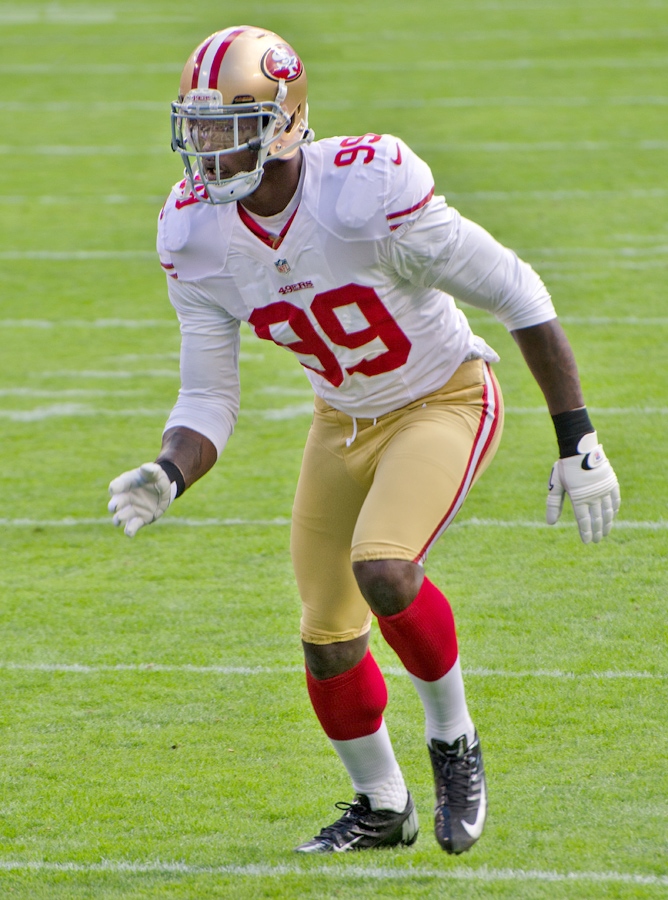
Aldon Smith died Saturday at 36, and the 49ers called it "sudden and tragic" without disclosing a cause. Before the box-score obituaries calcify into the same tidy arc — generational talent, wasted by bad choices — it's worth saying plainly what we spent a decade refusing to say while he was alive: Aldon Smith was not a character problem or a cautionary tale. He was a man with a disease, and we built an entire genre of sports commentary around watching it kill him in slow motion and calling it a discipline issue.
There is a number that still doesn't look real. In 2012, his second NFL season, Aldon Smith had 19.5 sacks. He got to 30 career sacks faster than anyone in the history of the league — faster than Reggie White, faster than Lawrence Taylor, faster than any of the names we reach for when we want to describe a force of nature wearing shoulder pads. He was 22 years old. He was the best pass rusher alive and it wasn't especially close.
He died Saturday at 36. The 49ers called it "sudden and tragic" and disclosed no cause, and I want to sit in that absence for a second before the internet fills it in, because the rush to fill it in is the whole story.
I don't know how Aldon Smith died. Neither do you. As I write this, no cause has been released, and anything beyond that is somebody's projection dressed up as knowledge. So this isn't that piece. I'm not going to perform certainty about a man's last hours to make a column land harder. What I want to talk about is the part we do know, the part that played out for a decade in full view: how we talked about him while he was alive.
Because we did talk about him. Constantly. And almost none of it was honest.
The vocabulary is what I can't get past. Aldon Smith was, in the language of the sport, a "headache." He had "off-field issues." He was a "distraction," a "locker-room concern," a "talent that couldn't stay out of his own way." When the suspensions piled up — and they piled up, multiple DUIs, a domestic violence arrest, the four years exiled from football entirely — the framing hardened into something almost moral. He had squandered it. He had been given everything. The tragedy, in the telling, was a tragedy of the gift, not the man: look at those sacks, look at what he threw away.
Read that again with the actual word swapped in. He was an alcoholic. He told us so himself, in 2014, leaving rehab, saying he was sober. He said it again in Dallas in 2020, sitting in front of cameras describing four years of trying to climb out, the most sobering stretch of his life. A man stood up repeatedly and named his disease, and the sports-content machine heard a redemption beat — the long journey back — and then, when he relapsed, heard a discipline failure. We never once heard a sick person telling us he was sick. We heard a story arc and we graded him on it.
This is the thing I keep banging on about, and Aldon Smith is the cruelest version of it: sports moralism is a scam. It is a machine for converting human suffering into a tidy lesson about character, because a lesson about character is more fun to consume than the truth, which is that addiction is a chronic, relapsing illness that does not care how many sacks you have. We do not say a diabetic "couldn't stay out of his own way." We do not say a man with cancer "squandered his gifts." But put a bottle in it and the disease becomes a verdict — on his discipline, his maturity, his want-to. We let ourselves believe that wanting it badly enough is a treatment plan. For athletes especially, whose entire mythology is built on overcoming through will, we treat the one disease that specifically attacks the will as a referendum on whether they have any.
And here's the part that should make the whole industry, mine included, sit very still: we made money on it the entire way down. The 19.5 sacks sold tickets. The arrests sold clicks. The 2020 comeback with Dallas — the long journey back, incentive-laden, a feel-good story for as long as it lasted — sold a redemption narrative we were happy to package right up until the 2021 DUI and the jail time in 2023, at which point we repackaged it as a cautionary tale and sold that too. There was no version of Aldon Smith that the content economy couldn't monetize. The triumph, the fall, the comeback, the relapse. Every chapter had a price and we charged it.
I loved watching him play. I want to be clear about that, because reverence is the right register here and I don't want the argument to flatten the awe. He bent the edge of an NFL offensive line like it was made of foil. He played in a Super Bowl. For about two years he was the most exciting non-quarterback in football, and if you watched the 2011 and 2012 Niners you know that the defense was the soul of those teams and he was the tip of the spear. That talent was real and it was his and nobody gave it to him; he earned every inch of it. The "he was given everything" framing is its own quiet insult.
What he was not given was a culture — ours, the fans', the media's, the league's — willing to see the illness instead of the incidents. The NFL has a substance-abuse program that functions, structurally, as a punishment apparatus: test, suspend, withhold pay, reinstate, repeat. It is built to police a personnel problem, not to treat a disease, and the distinction is not academic when the patient is a young man whose brain chemistry is at war with the very willpower everyone keeps demanding he summon. We had a treatable condition and we ran it through a disciplinary flowchart, and then we wrote columns about his choices.
I'm not interested in canonizing him. He hurt people; an arrest is not nothing, and the people on the other side of those incidents are not props in his redemption story. Honesty cuts both ways, and a disease is an explanation, never an absolution. But you can hold both. You can say a man caused real harm and say that the harm grew out of an illness we refused to treat as one, and that refusing to treat it as one made everything worse, for him and for everyone in his orbit. Those aren't competing claims. They're the same claim. The moralism that flattened him into a "bust" is the same moralism that made it harder for him to get well — because you cannot heal a thing you're being told is a character flaw.
So here is what I'd ask, in the window before the obituaries set like concrete. When you read that he "wasted" his talent, mentally swap in the real sentence: a man with a disease played some of the best football anyone's ever played, and then his disease took the rest. When you read "off-field issues," read "symptoms." When you read "couldn't stay out of his own way," read "was sick, and told us, and we filed it under discipline."
He was 36. He got to 30 sacks faster than any human being who has ever played the game. We spent a decade narrating the descent and calling it accountability. The least we can do now is stop pretending we were ever watching anything other than a sick man, living in public, while we sold tickets to the fall.
Rest easy, 99.
The Discussion
Loading…