San Francisco passed its first anti-vagrancy law in 1855 — a statute that explicitly used the slur "Greasers" to target Mexicans and Native Americans — and twelve years later enacted what historians confirm was the nation's first "ugly law," making it a misdemeanor to appear in public while visibly disabled. The city has been running the same play for 170 years.
As San Francisco continues to debate how aggressively to sweep homeless encampments and criminalize public poverty, a detailed historical essay by Darren Mckeeman — a researcher and novelist who has spent years studying Gold Rush-era San Francisco — traces an unbroken legislative thread from 1855 to the present. His core argument: the city has never chosen to house its most vulnerable residents; it has always chosen to prosecute their visibility.
The law that started it all was called the Anti-Vagrancy Act of 1855, passed by the California legislature five years after the Gold Rush ended and left thousands of broke, unemployed men camped across the city. The first section defined a vagrant as anyone unemployed, any sex worker, or anyone drunk in public — each punishable by up to 90 days in jail. The second section was blunter: it specifically named "Greasers," defined as persons of "Spanish and Indian blood," and authorized their disarmament on sight.
"You are free to do all of these things if you have a home to go to," Mckeeman writes in his essay, published on the Long Wharf Substack. "This is important later."
It was important almost immediately. The law was used to clear a sandlot at Stockton and Green Street — where homeless miners had encamped since the Gold Rush fizzled — in what Mckeeman identifies as probably San Francisco's first declared riot. The state militia was called in; people died.
The Emperor Who Only Avoided Jail Because a Friend Paid His Bills
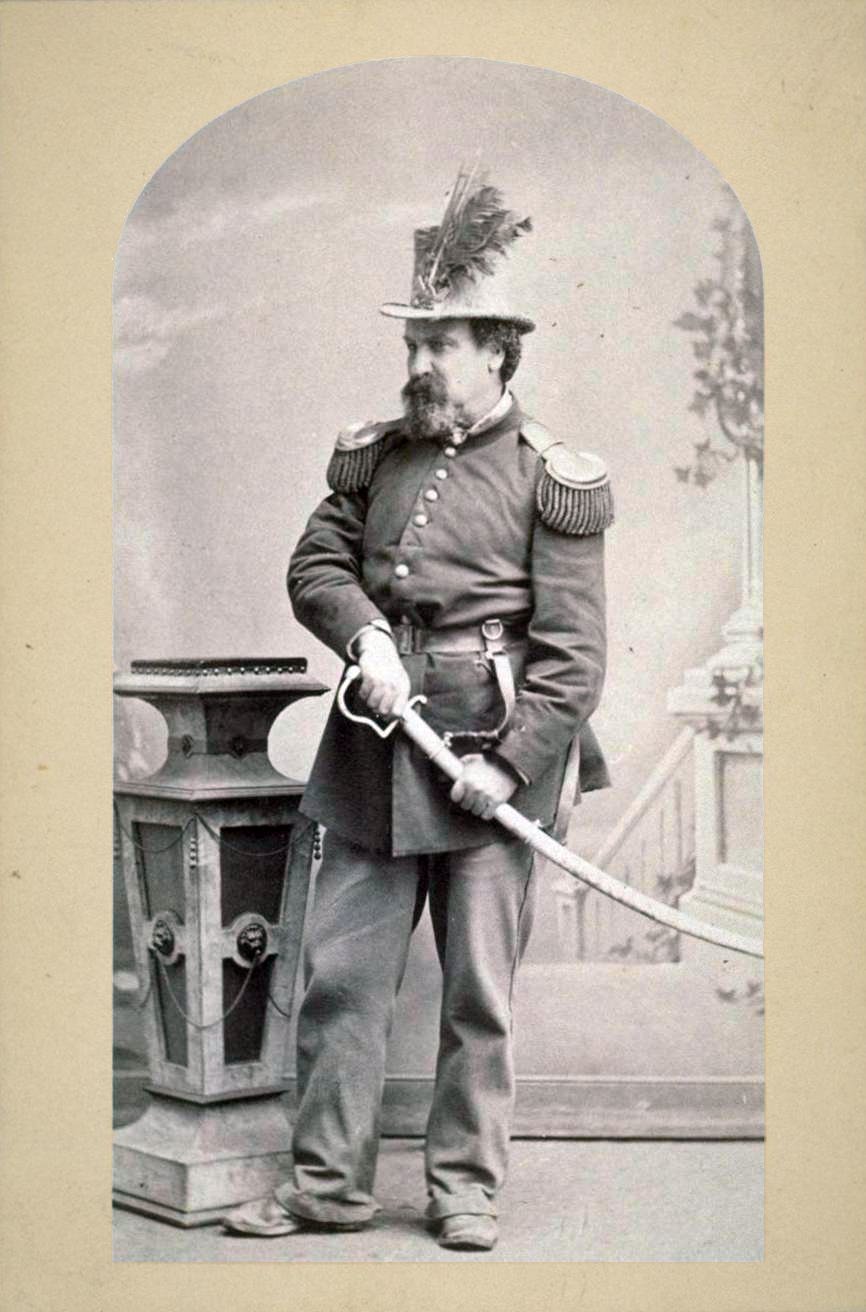
Into this landscape walked Joshua Norton, who had lost his fortune in the rice market in 1855 — the same year the Greaser Act passed — and by the early 1860s was parading the streets of San Francisco declaring himself Emperor of the United States. Norton became, and remains, one of the city's most beloved historical figures. What the tourism narrative omits is that he only escaped prosecution because a wealthy friend, Joseph Eastland, quietly paid his room and board.
"Without this help, Norton would be on the street and in jail," Mckeeman writes.
Norton drew a cohort of street characters — the Money King, George Washington the 2nd, a performer named Oofty Goofty who charged a dime for a punch and a quarter for a blow with a switch — and together they inadvertently created San Francisco's tourist economy. Mark Twain wrote about them. Visitors came specifically to see the city's eccentrics. The "elephant" they came to see was, in large part, its street people.
In 1867, a private security contractor named Armand Barbier tried to have Norton arrested on a vagrancy charge. A booking officer blocked it: Norton had a room key and more than $4 in his pocket. Both facts, under the law, made him not a vagrant. He was briefly held on a madness charge until the police chief intervened and released him.
The Nation's First Ugly Law — Also SF's
That same year, 1867, San Francisco passed what Wikipedia's entry on "ugly laws" — drawing on scholar Susan Schweik's 2009 academic history of the ordinances — identifies as the first such law in the United States. The ordinance read, in part: "Any person who is diseased, maimed, mutilated, or in any way deformed to be an unsightly or disgusting object or an improper person to be allowed in or on the streets, highways, thoroughfares or public places in the City or County of San Francisco, shall not therein or thereon expose himself or herself to public view."
The penalty was up to $25 in fines or 25 days in county jail. Other cities followed: Chicago in 1881, Portland in 1881, Denver and Lincoln in 1889. The last ugly laws were repealed in 1974.
The 1867 ordinance, Mckeeman notes, hit hardest the people least able to fight it: disabled Civil War veterans, who had flooded San Francisco's streets after 1865 with injuries that made their suffering visible. The city's solution was to make their presence illegal.
The Through-Line to Today
The legislative logic Mckeeman traces — that San Francisco responds to homeless visibility with criminalization rather than housing — is not a rhetorical stretch. It is the actual record. From the Greaser Act's 90-day jail terms for unemployment to the Ugly Law's fines for appearing disabled in public to the city's modern encampment sweeps and sit-lie ordinances, the tool has consistently been prosecution, not provision.
"I believe that the life of Emperor Norton is a good metaphor for our current homeless problems," Mckeeman writes. "Give them a home — it's as simple as that."
The Emperor himself had one, courtesy of a private patron. The city had nothing to do with it.
Darren Mckeeman's essay "San Francisco's History with the Homeless" is published at Long Wharf on Substack. The Greaser Act (California Anti-Vagrancy Act of 1855) and the 1867 San Francisco ordinance are documented in California state historical records and in Susan Schweik's "The Ugly Laws: Disability in Public" (NYU Press, 2009).
The Discussion
Loading…