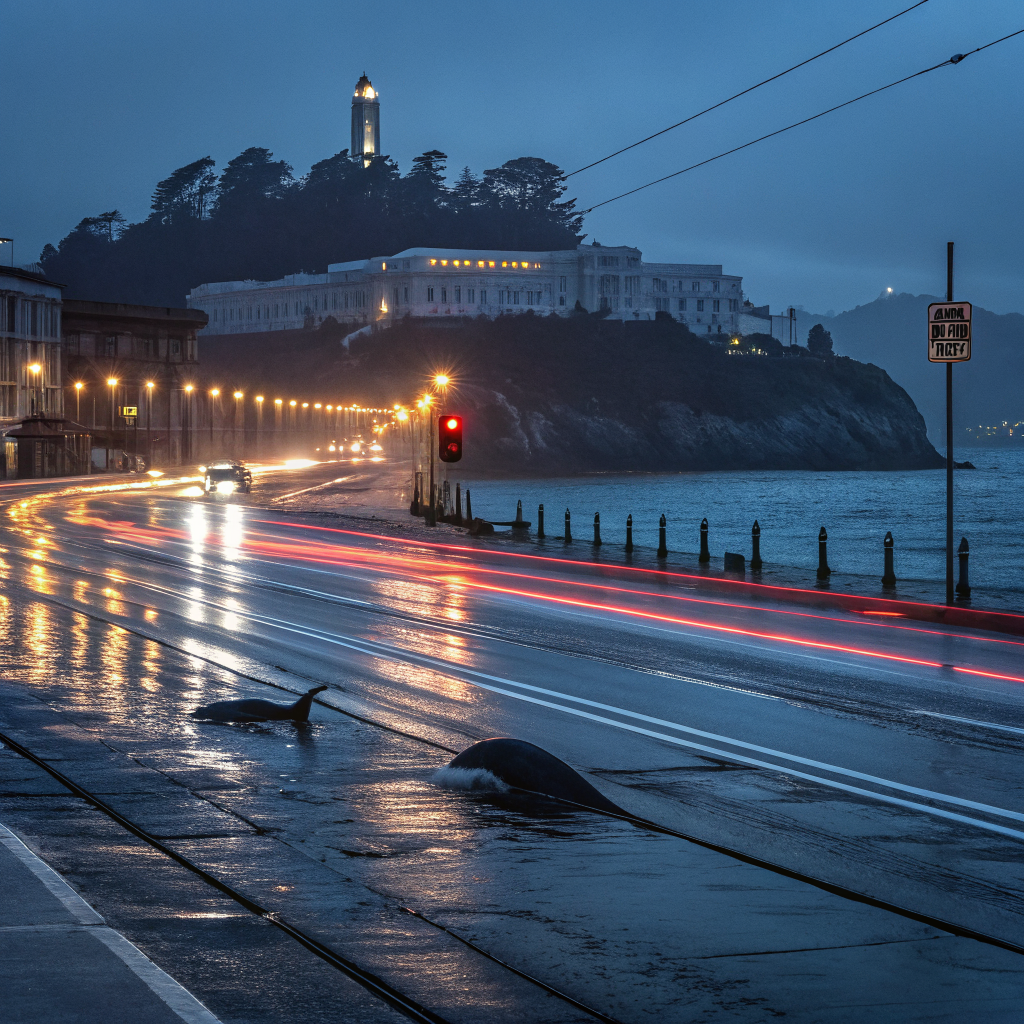
Driven off their normal Arctic feeding grounds by climate change, gray whales are foraging inside San Francisco Bay — and colliding with the shipping lanes that crisscross it. Seven of the sixteen whales documented in the Bay this year are dead, several from vessel strikes, prompting real-time ferry route changes and a new AI-powered detection system.
Sixteen gray whales have entered San Francisco Bay this year. Seven are dead — several killed by vessel strikes, their cause of death confirmed through necropsies performed by researchers from the Marine Mammal Center and the California Academy of Sciences. The bones of three of them lie in a row on a beach on Angel Island, the remnants of the season's autopsies.
The whales are detouring under the Golden Gate on their annual migration between Baja California and Alaska, where they traditionally spend summers building fat reserves in cold Arctic waters. Climate change is shrinking sea ice and reducing the tiny shrimp-like prey they depend on there, so some are now stopping to forage inside the Bay — near Alcatraz Island, near Alameda. "She died from injuries due to blunt force trauma from vessel strike," Kathi George, director of Cetacean Conservation Biology at the Marine Mammal Center, said of a female found dead this year.
The Bay is one of the busiest commercial waterways in the country, and the overlap with whale foraging territory has become a serious operational problem. Ferry operators have adjusted routes in real time when whales appear in high-traffic zones. A thermal camera installed on a Bay island detects heat from whale exhalations; an AI system screens potential sightings, confirms them with human operators, and relays alerts through the U.S. Coast Guard to vessel traffic. The system is called WhaleSpotter.
"We want the word to get out," said Gary Reed, director of Vessel Traffic Service San Francisco for the Coast Guard. "We want people to know there are whales in a particular location so they don't encounter them."
The Bay has been drawing whales for years — 61 individual humpbacks were identified between 2016 and 2018, according to a Marine Mammal Center study — but the toll is growing. Research published in Frontiers in Marine Science found roughly 18 percent of gray whales individually identified in the Bay later died there. In 2025, 22 gray whales died across the greater Bay Area, the highest count in 25 years, according to NPR. The North Pacific gray whale population now stands around 13,000, about half of what it was a decade ago.
"We're looking at a moment for gray whales where every whale that comes in and goes out of the bay matters for population," said Douglas McCauley, director of the Benioff Ocean Science Laboratory at UC Santa Barbara. "So even though this is just one piece of the problem, it's a piece that we want to solve, can solve."
The bones on Angel Island stay where they are for now — a visible record of the season's toll on a shoreline most Bay commuters will never set foot on.
The Discussion
Sign in to join the discussion.
Loading…