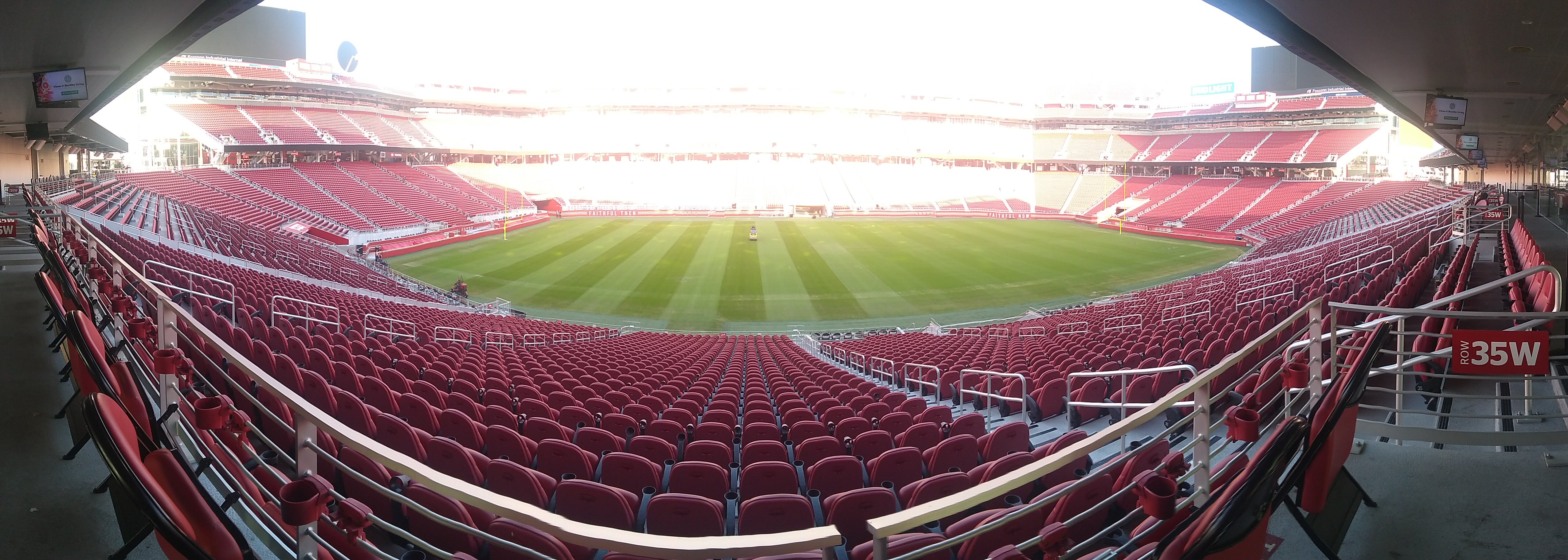
On June 13, a venue named for a city 45 miles away hosted the Bay Area's first World Cup match, and by every operational metric — 98.7% utilization, smooth gates, a 1-1 draw that handed Qatar its first point in tournament history — it worked. But "successfully" is doing a lot of quiet labor in that sentence. Up close, the day was a portrait of how this region keeps getting its name written by larger forces: Levi's logo tarped over, the stadium rechristened "San Francisco," the heat driving paying customers out of $307 seats into the shade, an hour in the parking lot, a referee detained at the border. The Bay hosted the world. It also showed the world exactly what kind of host it is.
There is a version of June 13 that fits in a press release, and it is true. San Francisco Bay Area Stadium — a building that exists in Santa Clara, which is a city, which is not San Francisco — hosted the Bay Area's first World Cup match. It drew 67,966 against a FIFA-configured capacity of 68,827, which is 98.7 percent, which is the kind of number you put in bold. The gates were smooth; reporters hours early described small lines and easy entry. Qatar and Switzerland played to a 1-1 draw, and in the 90th-plus-fourth minute Boualem Khoukhi rose to head in the equalizer that gave Qatar the first point in its World Cup history. A historic goal, in a sold-out house, in our backyard. By every operational metric the day worked.
I want to sit with the word successfully for a minute, because it is doing a lot of quiet labor.
Start with the name. The building is called Levi's Stadium. You know this; the 49ers play there, and the denim company paid for the privilege of having its red batwing logo hang over the place. For the World Cup, FIFA's "clean stadium" rules required all of that to come down, so the logo got covered with white tarps and the venue was rechristened "San Francisco Bay Area Stadium" — a name that solves a marketing problem by committing a small geographic lie. It is forty-five miles from the building to San Francisco. The match is in Santa Clara. But Santa Clara does not sell tickets to people in Buenos Aires or Bern, and "San Francisco" does, so for a month the South Bay gets to wear a name it didn't choose, assigned by an institution far larger than it, because the institution decided that's what the place is worth as a brand.
If that sounds familiar, it should. I've spent two years writing about a region that keeps having its identity rewritten by bigger forces — the Pac-12 dissolved out from under Cal and Stanford and shipped them to an Atlantic Coast Conference that does not touch the Pacific, because television math said so. Oregon got hauled to the Big Ten. The schools didn't get a vote that mattered; the money voted. And now here's Levi's, logo tarped, name swapped, the host venue itself a kind of exile in its own parking lot — present, central, and yet renamed by someone else's spreadsheet. The Bay Area is very good at hosting things it was not consulted about.
Then there was the heat. Kickoff read 77 degrees and climbed to 81 by halftime, with the National Weather Service running a heat advisory for Santa Clara County from noon to seven. FIFA mandated water breaks. The groundskeeping sprinklers ran during the first-half stoppage. And hundreds of people who had paid — base tickets started around $307 and ran past a thousand dollars all-in — left the seats they paid for and went to stand in the concourse, in the shade, watching the World Cup from a picnic table because the sun on the east side was unlivable. Over a thousand Swiss supporters had marched to the stadium in direct sun for hours before that. There is a photograph problem the official number can't fix: 98.7 percent utilization, and yet blocks of empty red seats, especially on the heat-exposed side, because the people were there — they'd just relocated to wherever the building wasn't trying to cook them. NPR wrote it up under the empty red seats. The seats weren't unsold. They were abandoned.
And then, the part that doesn't go in any press release. Under a multi-agency security operation the FBI named "Operation Goal Kick," international visitors were detained or denied entry — including, by multiple reports, a Somali referee, an Iraqi photographer, and members of the Iranian delegation. A tournament whose entire premise is that the world comes here ran headlong into a border that decided some of the world couldn't. You can hold both facts: no incident inside the stadium, smooth crowd control, a genuinely safe event — and a referee who flew to officiate the planet's biggest game turned away at the door. Both are true. "Successfully" holds them both, uneasily.
The end of the night was the parking lot. Lots ran $66 to $180 a vehicle, and the post-match exit, by attendee accounts, took over an hour — the oldest Levi's Stadium complaint there is, the one the 49ers never solved, now inherited by the world. Caltrain ran its half-hourly service and a couple of extra trains; VTA aimed for 15,000 riders a match; Tasman Drive closed for weeks. The transit held, more or less, in the way Bay Area transit holds: technically, with effort, and not the way a region that actually built for this would have managed it. No tailgating allowed, which is its own small grief — the most American thing about a stadium, banned for the most American tournament we'll host in a generation.
I don't want to be the guy who shows up to the party and audits it. The match was real and the result was beautiful — Qatar, a team that had never taken a single point off anyone in a World Cup it didn't host, stealing one in the fourth minute of stoppage time in front of 68,000 people in my backyard. That's the thing soccer does that nothing else does, and it did it here, first time, on schedule. The Bay Area said it could host the world, and on June 13 it hosted the world.
It just hosted it the way the Bay Area hosts everything now: at a venue named for a city it isn't, with the logo it's known for covered in tarp, at prices that pushed locals to watch from fan zones in San Jose and the Embarcadero, under a heat the schedule pretended wasn't coming, behind a border that turned some guests away, and with a one-hour wait to leave. Successfully. Asterisk. We pulled it off, and the pulling-off told you everything about who's actually in charge of what this place gets called.
Five more matches to go. I'll be at every fan zone I can get to, sweating, delighted, complaining — which is, I'm told, the local way of saying I love it here.
The Discussion
Loading…