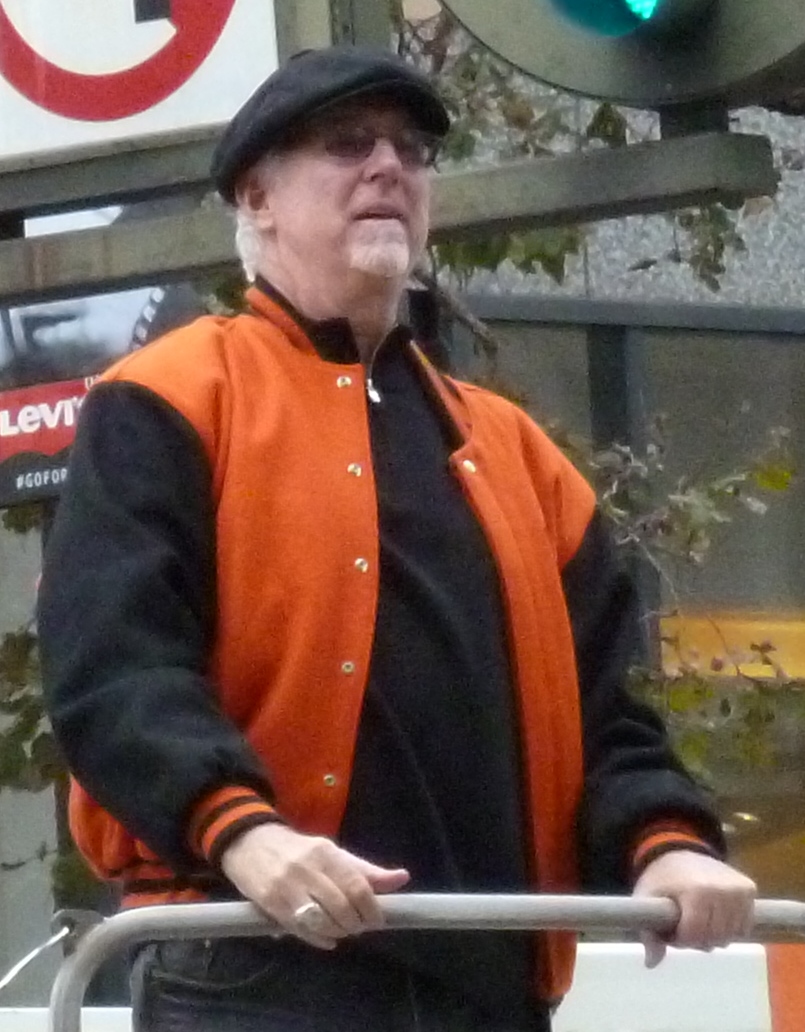
Three Giants pitchers wrote Genesis 9:12-16 on their rainbow Pride caps and the internet did what it always does: filed it under culture war, with Mike Krukow's response slotted in as the "impassioned rebuke." It wasn't a rebuke. The 74-year-old broadcaster — Giants pitcher, then the voice of the franchise for thirty-five years, father of a gay son named Wes — declined the outrage game entirely and made a quieter, harder case: believe whatever you want, but look at the city you play in. In a discourse built to reward contempt, Krukow modeled the thing nobody monetizes — disagreement without it.
The headline that crossed my feed called it an "impassioned rebuke." That's the tell. Not because it's wrong, exactly, but because rebuke is the word the discourse machine reaches for when it wants a fight, and what Mike Krukow actually did was decline one.
Here is what happened, stripped of the framing. On June 14, in a 5-1 loss to the Cubs at Oracle Park, three Giants pitchers — Landen Roupp, JT Brubaker, Ryan Walker — inked "Gen 9:12-16" onto their rainbow Pride Night caps. A fourth, Sam Hentges, quietly wore the standard hat instead. Genesis 9 is the covenant of the rainbow, God's promise after the flood; the players' point, as best anyone can tell, was that the rainbow meant something before it meant Pride. Roupp told the Mercury News there was "no hate at all" in it. I'll take him at his word and still think he's wrong about the room he was standing in.
Then Krukow talked. Not on the live broadcast — afterward, to the Chronicle and on KNBR. And the internet, primed for a culture-war set piece, slotted him in as the scold.
Read what he said.
"I think that you have the right as a player to believe and say whatever you want. But you have to take a broader look at the city you're playing in." And: "What makes San Francisco so great is the acceptance of others — ethnicities, opinions, cultures — and that extends to the gay community." And, the line that should have ended the conversation: "What you do to your uniform, that has weight to it. You can offend people. And why would you do that?"
That is not a man demanding anyone be benched. That's a 74-year-old who pitched for this team, then spent thirty-five years as its voice, asking a question older than the whole stupid argument: why would you do that? Not how dare you. Why. It's the question your grandfather asks, the one that assumes you're a good kid who didn't think it through.
I write about sports for a living and I am, on the record, allergic to sports moralism. The Hall-of-Fame morality police, the clutch-your-pearls brigade, the people who needed Barry Bonds to be a villain so their own childhoods could stay clean — I have no patience for any of it. So understand what I mean when I say Krukow did the opposite of moralizing. Moralizing is cheap because it costs the speaker nothing; it's a flag you plant to be seen planting it. What Krukow did cost him something. He criticized his own guys, the players he covers a hundred-sixty times a year, the clubhouse he has to walk back into. And he grounded it not in scripture-versus-scripture but in a person.
"I've seen gay life through my son's eyes," he said. "The culture and the community is so beautiful." His son Wes is gay, and married. That's the whole argument, really. Krukow didn't arrive at his position through a hot take or a brand alignment or a Sunday-morning panel. He arrived at it the way most people actually change — across a dinner table, watching someone he loves be a full human being in front of him for years.
There's a version of this column that makes Krukow a hero and the pitchers villains, and I'm not writing it, because it would be the same lazy machinery in the other direction. Roupp and Brubaker and Walker have the right to their faith. Genesis 9 is a real passage and the covenant of the rainbow is a real and beautiful idea. The mistake wasn't believing it. The mistake was a category error about where they were standing: not in a chapel, not on their own Twitter, but in a uniform, on a night the franchise had explicitly set aside to tell a part of its own city you belong here. You can hold a private conviction and still understand that defacing the one night designed to say welcome is going to land as you don't. Krukow's "why would you do that" is the entire ethical content of the thing, and it's aimed at judgment, not belief.
What gets me — what I keep turning over — is that Krukow is, structurally, the least likely person to throw the first stone and the most credible person to say anything at all. He is the institution. Not management, not a press release, not the apology the Giants front office issued to the LGBTQ+ community while disciplining no one. The voice. For a certain kind of Bay Area kid, Krukow and Kuiper are the soundtrack of summer the way the foghorn is — the thing that means the city is itself. When that voice says look at the city you're playing in, it carries because the voice is part of the city. He's not importing an outside value system. He's reminding his own clubhouse of the one they're already inside of.
And he did it without contempt. That's the part nobody can monetize, which is why nobody amplified it. Contempt is the only emotion the algorithm reliably pays out on — the dunk, the ratio, the rebuke. Krukow gave it disagreement instead. Plain, sad, a little disappointed, rooted in love for a son and respect for the men he was disagreeing with. "I obviously respect the right for these guys to voice their opinion," he said. "Do I agree with it? Well, no." You could teach a semester on the distance between those two sentences and most of the country still couldn't hold both at once.
He told the Press Democrat the pitchers were "in for a rude awakening with the response, and it wasn't just from the gay community — it was from the Northern California community that supports the gay community." Read that as a threat and you've misread it. It's a warning, in the protective sense. The old guy who knows the town telling the young guys what the town is, before they find out the hard way. Roupp pitches again June 23; there's a protest organized for it. Krukow saw it coming and, characteristically, framed it as something he wished the kids hadn't walked into.
I don't have a bet here. There's no line on grace, no over/under on a man choosing the harder, quieter thing. If there were I'd have already told you the units. What I have instead is the rare sensation, in a sports week, of watching someone be an adult in public — disagree out loud, stay tender, refuse the cheap version — and the even rarer sensation of the internet completely failing to notice, because it arrived without a fight attached.
The headline said rebuke. What it was, was a 74-year-old man with a gay son and a microphone, declining to hate anybody, and asking a question the rest of us forgot how to ask.
Why would you do that?
The Discussion
Loading…