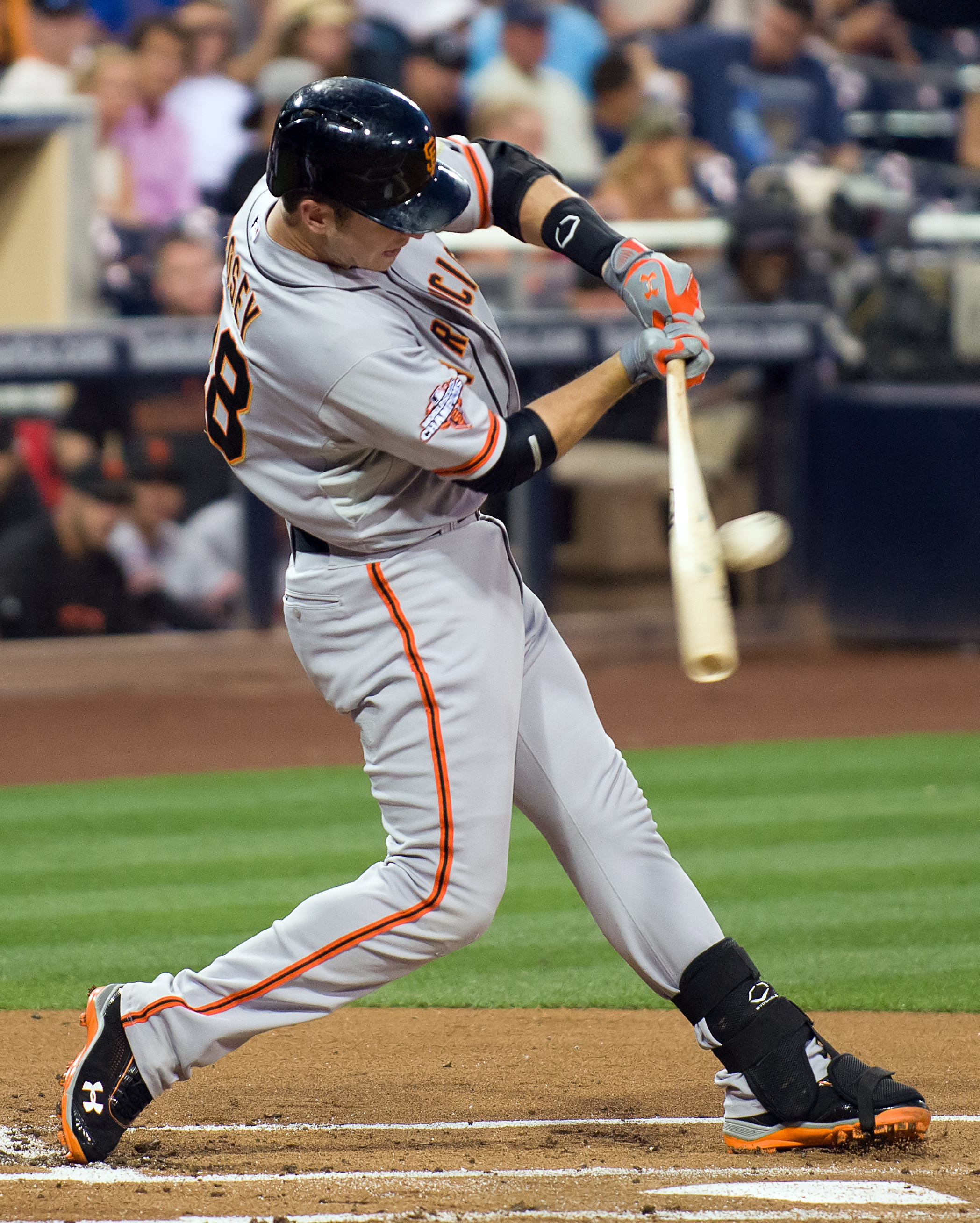
On August 2, a day before the deadline, Buster Posey traded a rental starter having a bad year to a desperate team for a 24-year-old who isn't in anybody's top thirty. The return doesn't matter. What matters is the direction: the catcher who spent a decade adding to this franchise — three rings, a batting title, the steadiest hands in the building — has decided, in his first summer running it, that the fastest way to make the Giants good is to make them worse first. Mahle for Molina is not a headline. It's a confession.
There's a version of this story that lasts one sentence and deserves to. On Saturday, a day before the deadline, the San Francisco Giants traded the right-handed starter Tyler Mahle to the Atlanta Braves for a 24-year-old pitcher named Anthony Molina, and if you have never heard of Anthony Molina, that is the appropriate and intended response. He is not in Atlanta's top thirty prospects. He carries no national ranking. He was pitching in Triple-A Gwinnett to a 4.14 ERA, a useful multi-inning arm the Braves shuttled up and down, and the Giants optioned him to Sacramento roughly the moment the paperwork cleared. This is not a blockbuster. This is a receipt.
But sit with it, because the smallness is the point.
Buster Posey spent thirteen years teaching this city what accumulation looks like. He caught three World Series. He won a batting title and an MVP. He was, by universal agreement, the most trusted man in any room he stood in — the guy whose framing stole strikes, whose at-bats felt like arguments he'd already won. Everything about his career was additive. More rings, more hardware, more reasons to believe the Giants were a serious operation. When he took over baseball operations, the romantic hope was that he'd keep adding, that the golden hands would simply reach into the front office and pull out another October.
Instead, his first real summer in the chair has been an education in the other thing. The unsexy thing. Subtraction.
Mahle was the easiest possible name to start with, which is exactly why he was the one to go. He signed a one-year, $10-million deal in January — a pure rental, zero years of control, the kind of bet a contender makes and a seller unwinds. He'd been mediocre: a 5.13 ERA, a 3-9 record across eighteen starts, the stat line of a pitcher on a team going nowhere. There was a flicker of value in there — the hamstring strain that cost him a month in June healed, and the stuff played better down the stretch than the season line suggests. But a good few weeks of a bad year on an expiring contract is not an asset you hold. It's an asset you move before it moves you.
And Atlanta needed him the way a drowning man needs a plank. Their rotation had come apart — Strider's elbow, López down, Schwellenbach gone for the season — leaving Chris Sale to anchor a staff held together with tape. When you are that desperate, you overpay, except the Giants weren't in a position to make Atlanta overpay. Reporting suggests the Cubs were the only other serious caller, and they didn't win it. That's not an auction. That's a motivated seller taking what the thin market offered: Atlanta assumed a couple million of the money owed, the Giants ate the rest — the signing bonus, the incentives — and everyone went home. San Francisco didn't trade Mahle for Molina so much as it traded him for the payroll flexibility, and Molina came stapled to the deal like a receipt to a return.
Here's what makes it interesting rather than depressing. The prelude to this was in May, when Posey sent Patrick Bailey — a Gold Glove catcher, a player at the position Posey himself defined here — to Cleveland for a prospect and a draft pick. Read those two moves together and a philosophy emerges, one that has nothing to do with sentiment. Posey is not protecting the things a former player might be tempted to protect. He moved a catcher. He moved a veteran arm. He is behaving like someone who has looked at a roster more than a dozen games under .500 and concluded, coldly, that the merciful thing is to stop pretending.
The ownership has apparently made its peace with this. Larry Baer, asked about handing the franchise's direction to a first-time executive, said the quiet part plainly: "We have faith in Buster. So if that was the recommendation, I don't think there'd be any pushback — if that's the way to make this franchise the best it can be over time." Over time. That's the phrase that should tell you where this is going. Nobody says "over time" about a team that thinks it's close.
I want to be honest about the register here, because it's easy to dress a salary dump up as strategy and it's just as easy to sneer at one. Mahle for Molina is, on its face, a nothing trade — a bad-year rental for a Quad-A depth arm, the kind of transaction that scrolls past on deadline day between the ones that actually move a pennant. If Molina becomes something, it'll be a pleasant surprise nobody in the room is counting on. The Giants didn't do this to acquire a pitcher. They did it to acquire room — on the books, on the roster, in the imagination.
But that's the thing about a rebuild. It never announces itself with the big move. It announces itself with the small one — the one where you realize the franchise has stopped treating this season as something to salvage and started treating it as something to clear. The Mahle trade is the Giants admitting, in the driest possible language, that 2026 is over and the point now is 2027 and beyond.
Posey knows this feeling from the other side. He spent his whole playing life being the answer teams traded for, the return that made a deadline a success. Now he's the man on the phone deciding which of his players is the return in someone else's celebration. There's no tragedy in it — this is the job, and doing it clear-eyed in your first summer is arguably the most Posey thing imaginable, the same refusal to flinch that made him great in the crouch. But there's a weight to watching the great accumulator learn the discipline of letting go. The hands that framed all those strikes are learning to give the ball away.
The selling spree has begun. Mahle was the first name, because he was the easy one. The hard ones — the players this city actually loves, the ones whose departures will hurt — those are the trades that tell us who Posey really is as an executive. This one just told us he's willing.
Line not pulled — this is analysis only; the game's already in the books and there's no bet here, just a franchise turning a page.
The Discussion
Loading…