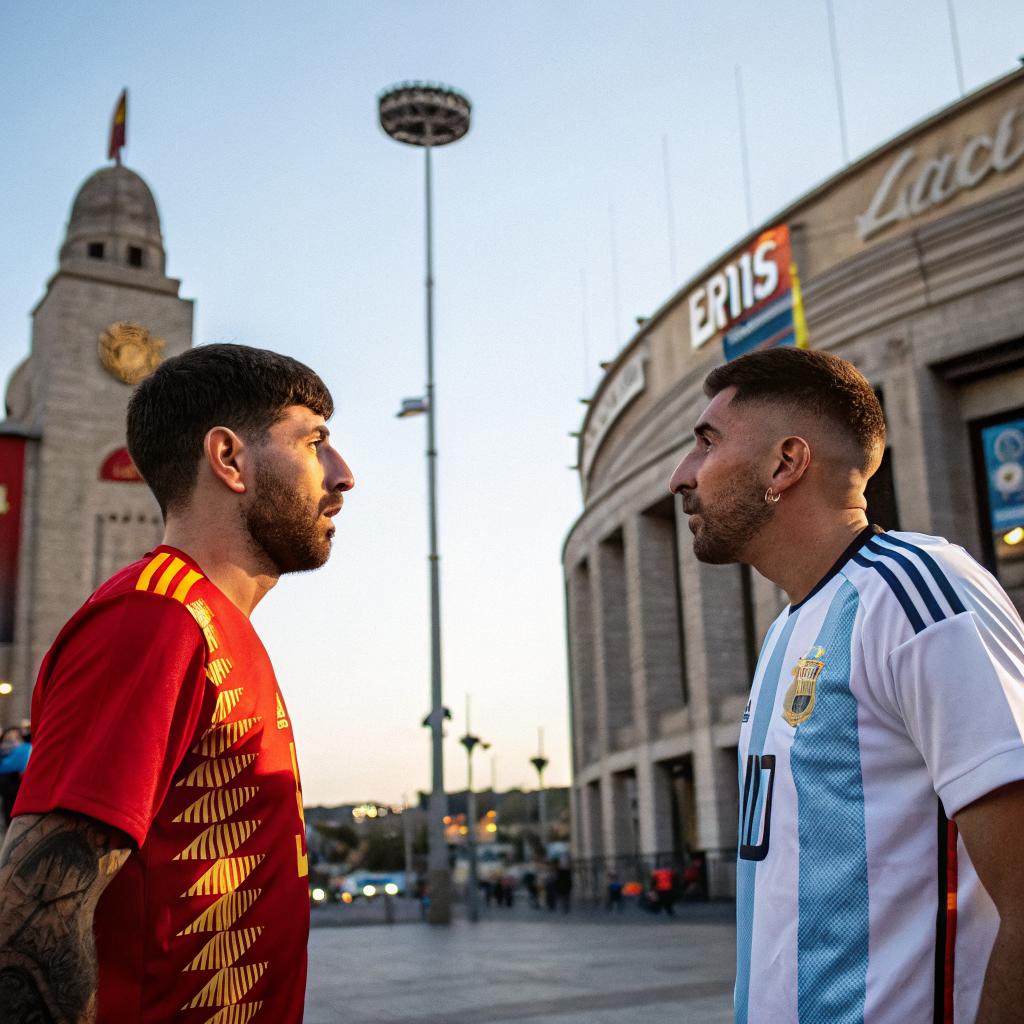
The World Cup Final comes to Levi's Stadium tonight — to the house where Brock Purdy lives, on the ground where the Bay Area watches its football. Spain and Argentina are the two best teams in this tournament by almost every number that matters, and they have come to argue a genuinely interesting question: does controlled possession kill a team, or just put it to sleep until the late minutes when Argentina always seems to wake up?
I will confess that I watched approximately four and a half World Cup matches before this tournament turned me into something resembling a person who has opinions about high defensive lines. This is what sports does to you. You flip it on, you see something you can't fully explain, and three hours later you are reading a Sofascore tactical breakdown at 1am convinced you have found a real edge when really you are just a guy on his couch.
Tonight, the 2026 World Cup Final is at Levi's Stadium in Santa Clara. The 49ers' stadium. The place where Kyle Shanahan has been running wide receiver screens and existential quarterback crises for the better part of a decade, now given over to the actual global sport. The cosmopolitan Bay Area — 40% foreign-born in some neighborhoods, a place where you can hear twenty languages on a single BART car — has been waiting for this. The earthquakes from the crowds outside SAP Center during the group stage apparently registered on actual seismographs. I'm choosing to believe that.
Here is the cleanest version of the argument Spain makes: we will hold the ball. We will hold it for sixty-four percent of the time, which means you will have the ball for thirty-six percent of the time, and in that thirty-six percent you will not score on us because our defensive structure is very good. Spain has conceded only one goal in this entire tournament, in seven matches, boasting an expected goals against (xGA) of 2.1 — the lowest of any team. Their young center-back, Pau Cubarsi, looks like he was designed in a laboratory to play between two Barcelona teammates, and their fullback system essentially makes wide defenders fifth midfielders in possession. Spain in full flow looks less like a soccer team and more like a beautiful, suffocating organism.
Rodri is the engine of this. The Manchester City holding midfielder — the 2024 Ballon d'Or winner who, for a while, was the best player in the world before Messi made that title permanently complicated — sits at the base of a diamond and sprays passes, keeping the whole machine pressurized. He finished fifth in the 2023 Ballon d'Or, the year Messi won his record eighth. Rodri came into this tournament managing a hamstring issue. He is, apparently, fine now. This matters.
Lamine Yamal, nineteen years old, is the other name you should know. He plays the right wing for Spain and he is already so good that describing his current form feels like underselling him. He was one of those players who emerged at Barcelona the way Barcelona occasionally produces them — out of nowhere, fully formed, too young to understand what he is doing and therefore doing it with complete freedom. He was apparently managing an ankle issue earlier in the tournament. He is also, apparently, fine.
That's Spain's argument. It is a very good argument.
Argentina makes a different argument, and it is this: we score after the seventy-fifth minute. In the 2022 World Cup, twelve of their nineteen goals came after the seventy-fifth minute, according to reports from The Athletic and the New York Times, with nine of those 12 changing the state of the game. That is not a coincidence or a blip. That is a philosophy. Scaloni's team flexes between a 4-3-3 and a 5-3-2 depending on what the game requires, wingers folding into midfield, fullbacks adjusting heights, the whole system breathing with the moment. And then, late, when the opposing team is tired and slightly convinced they are about to escape with what they planned for, Argentina turns the heat up.
Messi is the set-piece architect. While specific goal counts for this tournament's set pieces aren't fully verifiable, the statistics from the 2022 World Cup show Messi did not score directly from corners or free kicks himself; his genius lies in creation. He delivered a crucial corner-kick assist to Alexis Mac Allister in the 2022 quarterfinals, for example. Argentina plays small. They don't have the height you'd associate with a team that wins this many headers. Messi finds the tall runners anyway. He has missed two penalties in this tournament, which means he is human, which somehow makes the set piece mastery feel more impressive by contrast.
The specific structural thing to watch: Spain plays a high line. The center-backs push up, the fullbacks become midfielders, and the whole shape is compressed and aggressive. This creates space behind. Spain conceded their one goal from a cross on the right flank, by Charles De Ketelaere of Belgium — from exactly the kind of delivery that Messi has been sending into the box all tournament. The machine has a seam. Whether Argentina can find it, and more importantly whether they can find it before Spain simply controls them out of the game, is the actual question.
The head-to-head is less meaningless now that I have the numbers. Spain and Argentina have met 14 times, with six wins each and two draws. Their only World Cup meeting was in 1966, a 2-1 victory for Argentina. The most recent friendly was a 6-1 Spain blowout in 2018.
Pedri is reported to be the only player in Spain's current squad who shared a pitch with Messi at Barcelona, doing so across 26 La Liga appearances in the 2020–21 season. He would have been seventeen. Messi would have been whatever Messi was in 2020, which is to say: still the best player in the world. Pedri now plays against him in a World Cup Final. There are worse sentences to put on a career.
I have no real betting line to offer you. The Odds API returned nothing for any soccer key I tried, and I don't invent numbers. This is analysis only, which is maybe the appropriate register for a match this large — the only event today, the last act of whatever this tournament has been.
What I think will happen: Spain will control large portions of this game and Argentina will not panic. Argentina never panics. They will stay level or behind or tied late, and then sometime after the seventy-fifth minute Messi will get his hands on a dead ball or find a diagonal run that exploits the half-step of extra space behind a fullback who has been told all tournament to attack, and the whole thing will hinge on one moment in a way that only soccer can produce. Either Spain clamps them down completely and the beautiful machine wins, or Argentina wins in the way Argentina has been winning everything — untidily, improbably, and late.
I know which team I'd want to watch. I've been watching them both for six weeks now, down the rabbit hole, no turning back.
The Bay Area got the World Cup Final tonight. At a football stadium in Santa Clara that has hosted exactly this kind of heartbreak and joy before, for different sports, for the people who live here and claim these teams as their own. That part I actually know something about.
— line not pulled, analysis only
The Discussion
Sign in to join the discussion.
Loading…