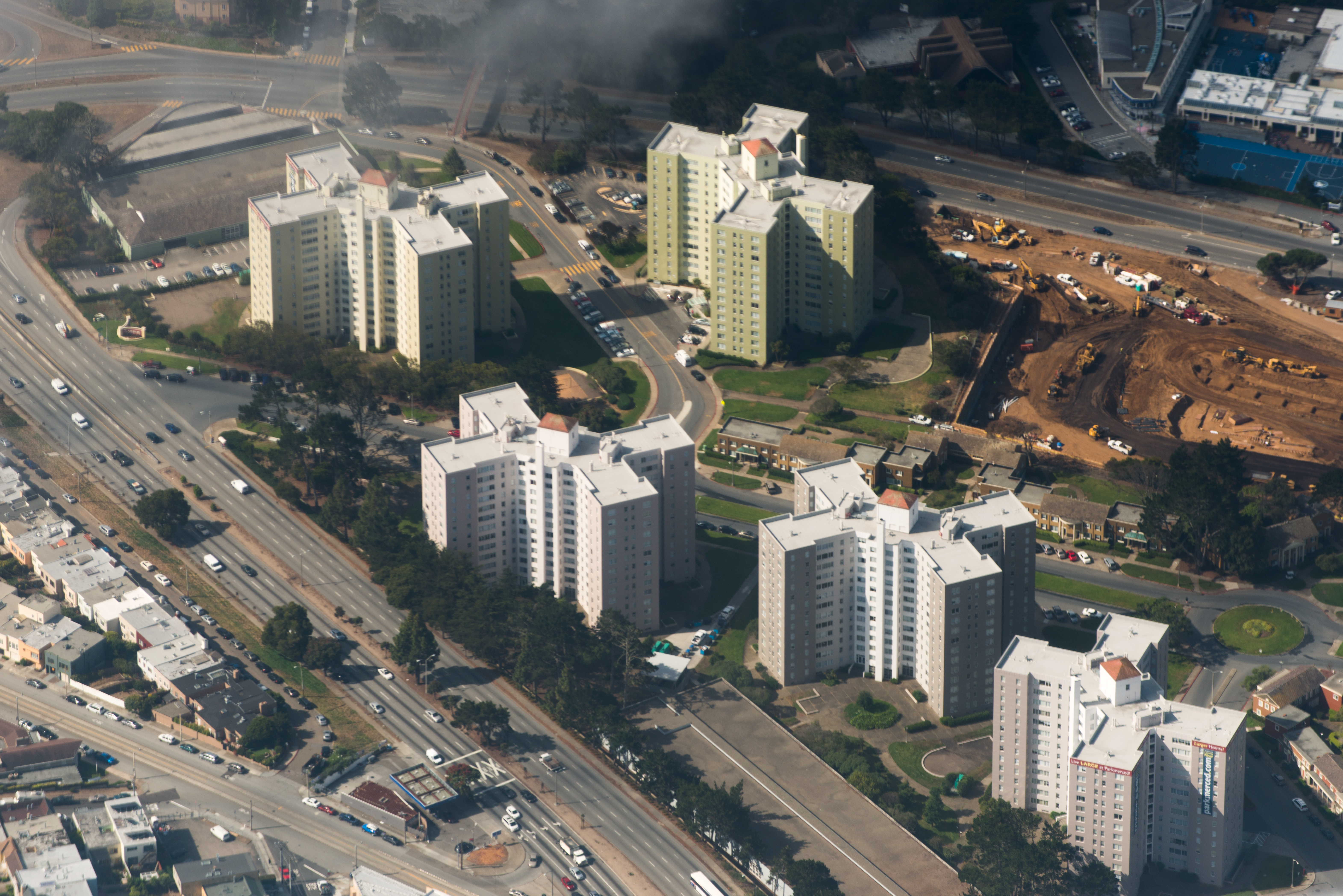
Parkmerced has been run by a court-appointed receiver since last year, after Maximus Real Estate Partners defaulted on $1.8 billion in debt. Its founder Rob Rosania is still trying to pitch investors on the redevelopment he never built.
The collapse of Maximus Real Estate Partners is more than a cautionary tale about a real estate dealmaker who ran out of runway. For San Francisco, it means the 5,600 new homes that the city's Board of Supervisors greenlighted in 2011 — a project that would have tripled Parkmerced's capacity and added Muni service to the 152-acre campus — are now deep in legal and financial limbo, at exactly the moment the city can least afford it. More than 3,000 households currently living there are also navigating a complex now managed by outside receivers rather than its longtime landlord.
Parkmerced sits on 152 acres of western San Francisco, home to more than 3,000 households in a mix of towers and garden apartments that have defined the neighborhood since the 1940s. For the past two decades, it has also been the centerpiece of one of the city's most ambitious — and ultimately unfulfilled — housing promises.
In 2011, the San Francisco Board of Supervisors approved a Maximus Real Estate Partners plan to build more than 5,600 units on the site, tripling the complex's capacity and adding stops on the Muni M line. The project, had it been built, would have been one of the largest infill housing developments in the city's history. Instead, Maximus never broke ground.
What Maximus did instead, the SF Standard reported this week in a detailed investigation, was refinance: in 2010, 2014, and 2019, the company leveraged the property deeper with each loan, betting each time that the promise of future construction was worth more than what was actually owed. By the time that bet came due, the debt had ballooned to $1.8 billion, according to The Real Deal, which reported last year that the loan had gone to special servicing.
A court-appointed receiver, Douglas Wilson, took control of Parkmerced in 2025 with plans to invest $70 million to stabilize the complex, according to The Real Deal. The entitlements for the 5,600 units — the legal permission to build — remain tied up in the receivership, their future uncertain.
Meanwhile, inside what remains of Maximus, the situation has grown grim. The SF Standard obtained a recording of a March 26 emergency all-hands meeting in which company founder Rob Rosania told employees — who had already missed their second paycheck in five months — that a deal was imminent. He described meetings in New York, unnamed investment groups, and a timeline measured in weeks.
"We're at a moment of conviction," Rosania said twice on the call, according to the Standard's reporting. "There's no doubt in my mind that we're making a deal."
Near the end of the meeting, YuSun Han, who has served as managing director of development since 2014, asked: "What do you need from us?"
Rosania's answer: "Prayer."
The company's other properties had already slipped away by then. Maximus gave up operational control of The Cove, a 248-unit luxury complex in Tiburon, after restructuring its loan there. Two East Bay apartment buildings were sold off. The company's offices at One Maritime Plaza are gone. Its website is dark. Key executives have departed — chief operating officer Ben Green left last month for Strata Family Office Services, according to his LinkedIn profile; his predecessor Fred Knapp left in 2023.
What remains is a small inner circle, a San Leandro parcel entitled for 697 units that never broke ground, and Rosania's pitch.
It follows a pattern. Before Parkmerced, Rosania spent years trying to develop what critics called the "Monster in the Mission" — a market-rate tower at 16th and Mission that consumed more than $42 million in land and consultancy costs before Maximus sold the site to Crescent Heights in 2021. Crescent Heights ultimately donated the land to the city for affordable housing.
For Parkmerced's existing tenants, the receivership has stabilized day-to-day management under Fairfield Residential, a San Diego-based firm now handling leasing and operations. But the larger question — whether the complex ever gets rebuilt as promised, and whether 5,600 homes the city badly needs ever materialize — has no clear answer.
San Francisco has struggled for years to build its way out of a housing shortage. Parkmerced was supposed to be part of the solution. Two decades of refinancing later, the courts run the complex, the developer is chasing investors, and the city's largest housing campus remains largely unchanged from when Maximus first acquired it.
The Discussion
Loading…