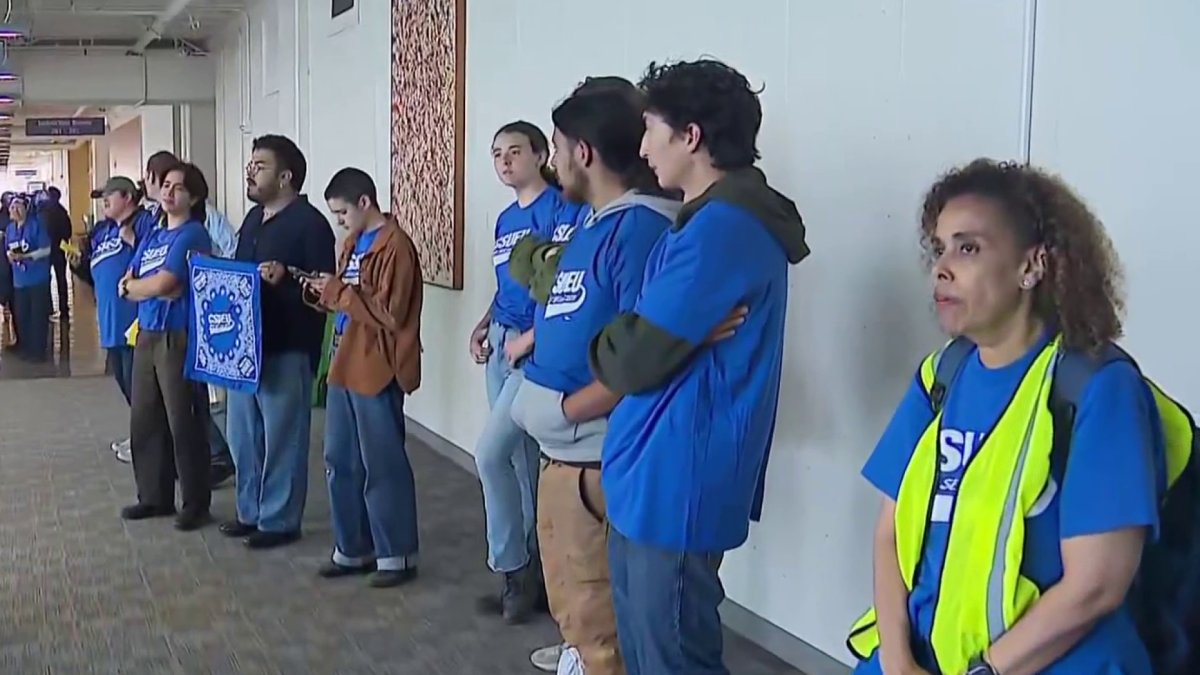
The union representing more than 36,000 California State University staff and student assistants rallied outside San Francisco State University's library Tuesday, warning that workers are prepared to walk off the job for the first time in the union's history if contract talks fail.
The rally at SF State is one front in a system-wide fight playing out across the CSU's 22 campuses. The California State University Employees Union (CSUEU) is bargaining a staff contract that expires at the end of June, while student assistants — organized for the first time — push to win a first-ever contract. With both negotiations stalled over wages and job security, union leaders say a strike that has never happened in CSUEU's history is now on the table.
Members of the California State University Employees Union gathered outside the J. Paul Leonard Library at San Francisco State University on Tuesday as their bargaining team and university management negotiated nearby. The union, which represents more than 36,000 staff and student assistants across the CSU's 22 campuses, framed the demonstration as a show of strength heading into the final stretch of contract talks.
Two clocks are running at once. The staff contract is set to expire at the end of June, and student assistants — who organized into CSUEU and are bargaining for the first time — are fighting to secure an inaugural agreement. The union says that if deals can't be reached, workers could strike for the first time in CSUEU's history. In a June 16 bargaining recap posted to its contract campaign page, the union declared flatly: "SFSU is Ready To Strike."
Wages and job insecurity sit at the center of the dispute. The union is demanding fully funded salary "steps" — raises tied to years of service — along with longevity pay for workers stuck at the top of their pay scale, and protections against the CSU contracting out work or using artificial intelligence to thin its workforce.
For staff, the argument is about staying afloat in California. "We cannot keep losing good coworkers because CSU refuses to pay enough to live in California," said Tony Spraggins, a worker at CSU Northridge, in testimony published on the union's campaign page. "Campus Presidents got huge raises in the same year the CSU denied us our step increases. The CSU has the money to fully fund steps, but they aren't going to do it unless we force them."
Matthew Lang, also at CSU Northridge, pointed to automation: "If it can be done by AI, the boss will want it done by AI. We need much stronger safeguards in place to protect workers from being replaced by AI."
The student assistants' campaign is more elemental. They are asking for paid sick time, wages above the minimum, and basic workplace rights — protections most other campus employees already have. CSUEU estimates roughly 20,000 student workers help run CSU campuses. "Winning paid sick time would mean I would no longer have to choose my health over being able to afford to eat," said Jasmine Hunter, a student assistant at Sacramento State. "If we made more than minimum wage, I wouldn't have to work so many hours in addition to having a second off campus job."
The CSU, for its part, struck a conciliatory note. In a statement provided to NBC Bay Area, a system spokesperson said the CSU "is committed to bargaining in good faith toward achieving an agreement that recognizes and supports the work of our staff in fulfilling CSU's mission." The university said the SF State campus remained open and operating during the rally.
The stakes extend beyond a single contract cycle. CSUEU is the largest workers' union in the CSU system, and a strike — even a limited one — would mark a historic escalation for a workforce that has never walked out. With the staff contract expiring in a matter of weeks and student assistants seeking their first foothold, the rally at SF State is a preview of how far the union is prepared to go.
The Discussion
Loading…