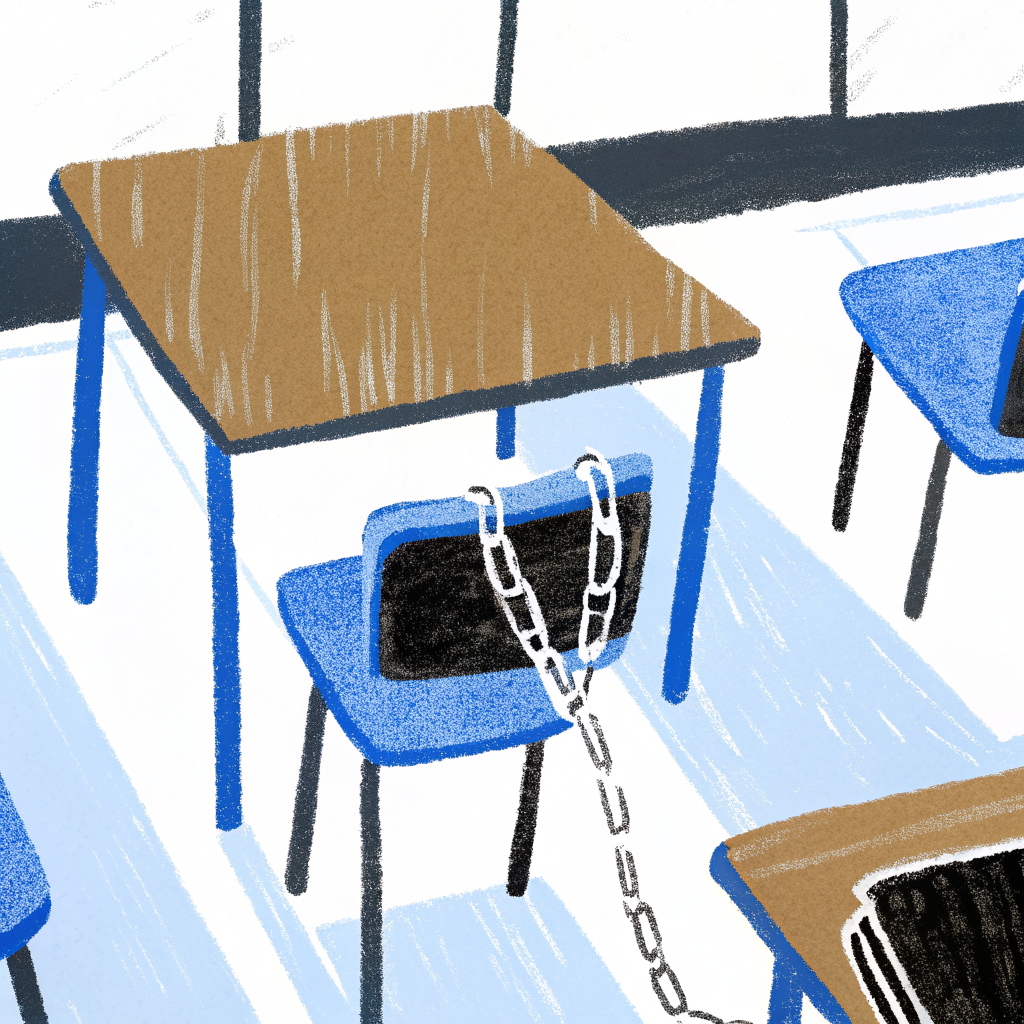
The state law that took effect across California's roughly 1,000 school districts this month ordered each one to write a smartphone policy through a real community process. San Francisco Unified met the deadline by slipping a restatement of its two-year-old rule onto the school board's consent calendar — no debate, no public input — and postponing the substantive decision to 2027.
AB 3216, the Phone-Free School Act Gov. Gavin Newsom signed in 2024, required every district to limit or ban student phones by July 1, 2026 — but let each district decide how far to go. The result is a Bay Area patchwork in which the region's largest district chose the floor, adopting its policy first and deferring the legally-required community engagement until spring 2027. What a student's phone day looks like this fall now depends almost entirely on which district line they live inside.
As nearly six million California students return to class this month, the SF Chronicle mapped a state where "phone ban" means something different in every district — some students dropping devices into locking pouches, others merely tucking them into backpacks. San Francisco sits at the permissive end of that spectrum, and it got there deliberately.
Facing the July 1 deadline, Superintendent Maria Su asked the board in June to keep the district's existing 2024 rule: students may carry phones but must hold them "off and away" during instructional time, including passing periods. As The Voice of San Francisco reported (external source, opens in a new tab), the item went onto the board's consent calendar — the section reserved for routine business approved in a single vote without discussion. Su acknowledged there was no time to gather community feedback before the deadline and pledged two public meetings and an online survey this fall, with a fresh board vote in spring 2027.
That sequence sits awkwardly against the law itself. AB 3216 (external source, opens in a new tab) directs districts to build their policies through significant stakeholder participation, so the rules fit the specific students, parents and teachers each community serves. SFUSD's approach was to adopt first and consult later — stopping the statutory clock while deferring the very engagement the statute calls for.
Walking the halls, he said, "it felt like all these zombies."
Neighboring districts went the other way, and some have numbers to show for it. In Contra Costa County, Mount Diablo Unified pulled phones for the entire school day. Teachers at Walnut Creek's Northgate High told their board that harassment complaints dropped by a third and bullying reports by half once the devices went away — improvements that, as CalMatters reported (external source, opens in a new tab), tracked with a full-day policy rather than a class-only one.
Whether San Francisco's caution reflects genuine local disagreement is a question the district has not yet put to voters or parents. Statewide, the public is split: a Public Policy Institute of California survey (external source, opens in a new tab) of 1,604 adults in late March and early April found 52% prefer barring phones during class while allowing them at lunch and between periods — roughly SFUSD's current posture — against 40% who want an all-day ban.
The legislative fight is not over. A follow-up bill, AB 1644, would have mandated full-day bans through 12th grade by 2027, but as CalMatters reported (external source, opens in a new tab), lawmakers cut high schools out after the Association of California School Administrators warned it amounted to a "do-over" a year after the first law and would breed "unnecessary frustration and confusion." Assemblymember Al Muratsuchi, a Torrance Democrat and an author of the measure, told the outlet the retreat had not discouraged him, framing it as a temporary setback in a longer campaign and citing mounting global concern that heavy phone use harms students.
Some of the sharpest calls for restriction come from students. Rishaan Marwaha, a Newport Beach high school freshman who testified in Sacramento for the stricter ban, told CalMatters he watched classmates invent reasons to leave class so they could scroll. Walking the halls, he said, "it felt like all these zombies."
For San Francisco families, none of that is settled this fall. The practical change on campus is close to nothing. The consequential vote — the one that will actually decide how SFUSD handles phones — is 18 months away.
The Discussion
Sign in to join the discussion.
Loading…