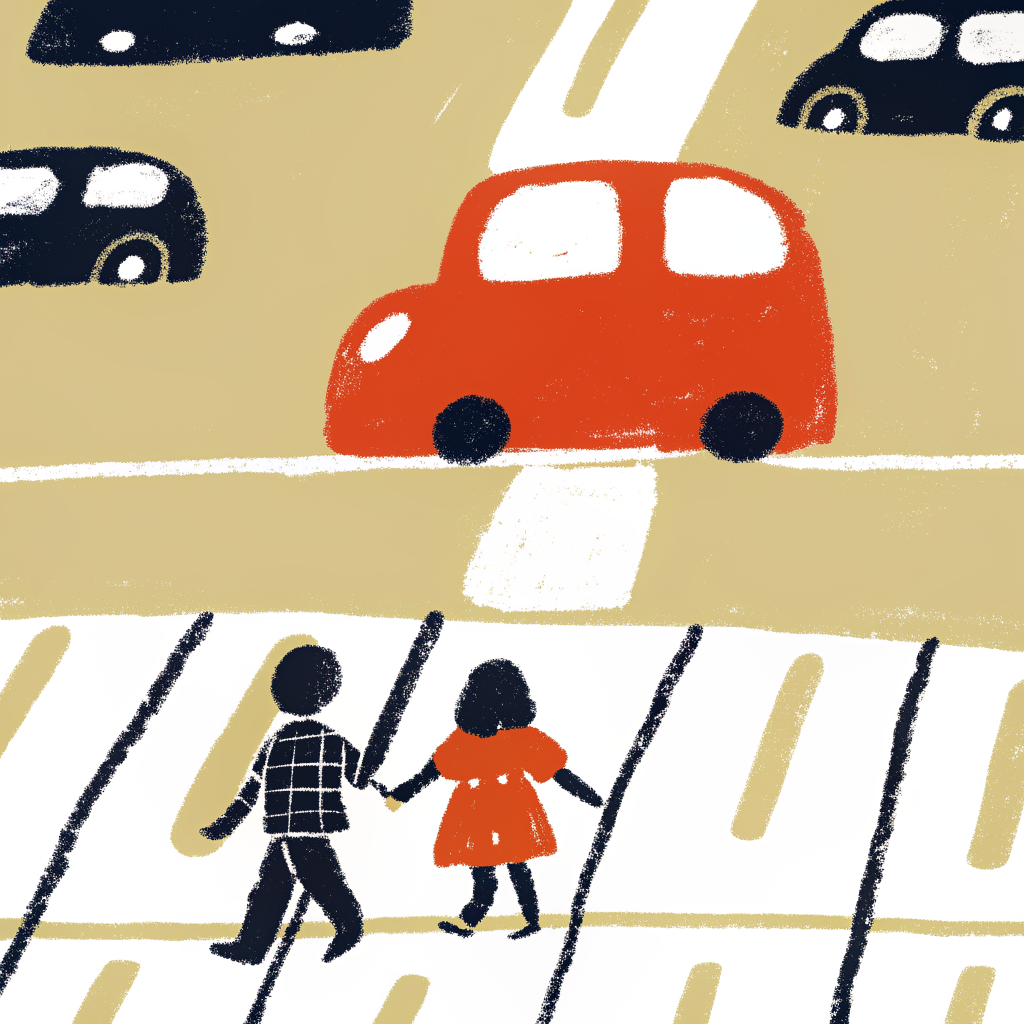
San Francisco greeted roughly 50,000 returning students this week by installing 15-mph signs near six schools — the first sliver of a plan to lower speed limits at more than 230 campuses. But the new state law the city is invoking doesn't force drivers to slow down statewide until 2031, and the cheapest part of the fix is the one going in first.
At a Friday press conference outside Leonard R. Flynn Elementary in the Mission, Mayor Daniel Lurie and SFMTA officials framed the lower limits as a signature child-safety win. The tool is Assembly Bill 382, a 2025 law that lets cities post 15 or 20 mph in school zones. The gap the announcement glides past: signs are the fast, cheap lever, while the enforcement, crossing guards and street redesigns that actually change driver behavior are constrained by a $300 million SFMTA deficit — and the city's own data shows the most serious crashes still rising.
San Francisco is telling parents their kids' walk to school is about to get safer. The evidence the city offered this week was a set of new speed-limit signs.
At a Friday event outside Leonard R. Flynn Elementary (external source, opens in a new tab) in the Mission, SFMTA and Mayor Daniel Lurie announced that six schools are the first to get lower posted limits — 15 mph on single-lane streets, 20 mph on wider arterials — with the agency promising to reach more than 230 public and private schools by 2028. The other five first-wave campuses, per the San Francisco Examiner (external source, opens in a new tab), are St. Anthony-Immaculate Conception, Jefferson Elementary, Dr. William L. Cobb Elementary, Roosevelt Middle and the Ruth Asawa San Francisco School of the Arts.
The legal engine is Assembly Bill 382 (external source, opens in a new tab), authored by Peninsula Assemblymember Marc Berman and signed by Gov. Gavin Newsom in October 2025. Read the bill and the timing is less triumphant than the podium suggested. AB 382 lets local agencies opt into lower limits now, but its statewide mandate — a default 20-mph prima facie limit in school zones — does not take effect until Jan. 1, 2031, as a legal analysis (external source, opens in a new tab) of the law lays out. San Francisco is moving early, but it is choosing the slowest, cheapest instrument in the box first: paint and metal.
That matters because posted numbers, on their own, are weak medicine. What actually changes how fast people drive is a mix the city itself touted Friday: automated speed cameras, crossing guards, and physical redesigns like daylighted intersections and high-visibility crosswalks. A number on a pole mostly slows drivers when someone is enforcing it — which is why SFPD Chief Derrick Lew's promise of "high visibility enforcement" and "zero tolerance for dangerous driving" around schools may matter more than the signs themselves. All of those tools cost money the sign program does not.
The city's own budget is the constraint. SFMTA spokesperson Madhu Unnikrishnan said the agency held crossing guards at last year's level — roughly 174 corners at 96 schools — despite a structural deficit north of $300 million. That is a real choice worth crediting. It also means that outside those 96 schools, and in the years before signs reach all 230 campuses, the protection is thin.
The safety record does not support a victory lap. Vision Zero, the city's decade-long pledge to eliminate traffic deaths, expired in 2024 — the deadliest year since it began, with 42 people killed. Seventeen have died on city streets so far in 2026. And an SFMTA street-safety committee report cited by KQED found a divergence that undercuts the good news: total injury crashes are falling, but the crashes that leave people severely hurt are becoming more common, not less.
For the families at Flynn, the danger is specific and geographic. Emberly Garibay, 11, who has two younger siblings at the school, described to KQED how unsafe crossing Cesar Chavez Street's four lanes can feel: "I don't feel safe sometimes... People are just going too fast." Ryan Hazelton, who runs the Mariposa Kids afterschool program at Flynn and is running for the school board, told KQED that the pedestrian signal on Cesar Chavez is about five seconds too short to move a group of kids across safely — a design flaw a 15-mph sign a block away does nothing to fix.
None of this makes lower limits a bad idea. It makes them a first step the city is presenting as a finish line. The honest version of Friday's announcement is that San Francisco has three more years of sign installations ahead, a five-year wait for the state to make 20 mph the default, a $300 million budget hole, and its most serious crashes still moving the wrong way — and it is starting with the part that costs the least.
The Discussion
Sign in to join the discussion.
Loading…