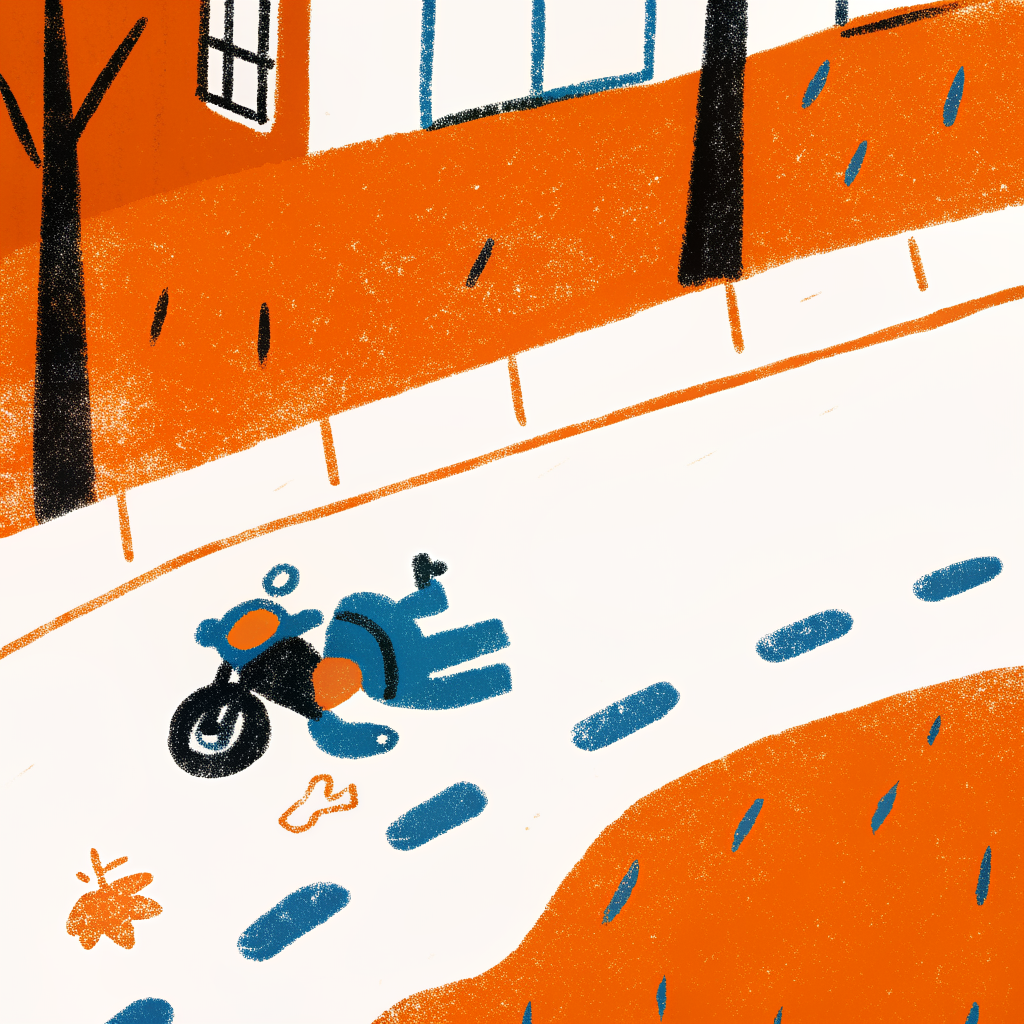
A man in his 20s riding a motorcycle south on El Camino Real was killed Wednesday afternoon when a sedan turned left across his path — a death at the Palo Alto end of a state highway that Caltrans declared safer just ten months ago, after a $55 million rebuild the city had warned, in writing, would leave the corridor's deadliest kind of crash unaddressed.
The collision happened near the Stanford Shopping Center, by Sand Hill Road — the northern boundary of Caltrans' $55 million State Route 82 pavement and accessibility project, which the agency celebrated as finished in October 2025. Nineteen months before that ribbon-cutting, Palo Alto's own consultants and its planning commission had flagged what the plan skipped: the turning conflicts at intersections that the state's crash data identify as the corridor's most common. Wednesday's fatal crash was one of those turning conflicts. The rider has not been publicly named.
Palo Alto police say the rider was heading south on El Camino shortly before 4:30 p.m. Wednesday when a northbound sedan turned left toward a business and the two collided. He was thrown from the motorcycle, taken to a hospital, and died of his injuries. The driver, a woman in her 20s, stayed at the scene and cooperated with investigators, who kept El Camino shut for roughly three hours while they worked it. The cause is still under investigation; the department has asked anyone who saw the crash to call its 24-hour line at 650-329-2413.
That is the blotter. Where it happened is the story.
Last October, Caltrans and local officials gathered to mark the completion of a $55 million overhaul (external source, opens in a new tab) of this stretch of El Camino: fresh pavement, more than 13 miles of new bike lanes, rebuilt curb ramps, upgraded signals, and three pedestrian hybrid beacons. By the agency's own description, the work ran from Mountain View north to Sand Hill Road in Palo Alto — the very junction where a man was killed this week. District 4 Director Dave Ambuehl called the effort "more than repaving a road," describing a corridor made safer for everyone who travels it.
What the ceremony left out is that Palo Alto had studied the design well before it was built and told Caltrans, on the record, that it did not go far enough. In early 2024, as the state pushed its plan, the city's Planning and Transportation Commission took up a "safe streets" review (external source, opens in a new tab) of the corridor. The outside firm the city hired, Fehr & Peers, concluded the Caltrans design was not consistent with the "safe system" approach the state and city both claim to follow — an approach whose first move is to slow traffic. The plan, the reviewers found, kept the same travel lanes at the same widths while removing the on-street parking that currently forces drivers to ease off, and it did not address the speed of turning movements at intersections, where the corridor's collisions are concentrated.
District 4 Director Dave Ambuehl called the effort "more than repaving a road," describing a corridor made safer for everyone who travels it.
The city did not keep those objections internal. On March 14, 2024, Palo Alto sent Caltrans District Director Dina El-Tawansy a formal letter (external source, opens in a new tab) laying out its requested changes to the El Camino plan. Caltrans adjusted some elements and built the corridor.
A sedan turning left across oncoming traffic is precisely the conflict the review singled out: a turning movement at a junction, the pattern the state's own figures call the road's most frequent, and the one critics said the project walked past.
The honest caveat belongs here. The review's sharpest focus was the bike-lane component, and Wednesday's victim was a motorcyclist, not a cyclist. No one can say a different layout would have kept him alive, and the police investigation into fault is not finished. But the city's warning was never only about bikes. It was that a project sold as a safety upgrade resurfaced El Camino without changing the geometry — or the speed — of how vehicles turn across it.
That is the question a fatal left turn now puts to the agency that spent $55 million on this road, and to the city that predicted, in a letter it can point to, that the money was not going where people were getting hurt.
The Discussion
Sign in to join the discussion.
Loading…