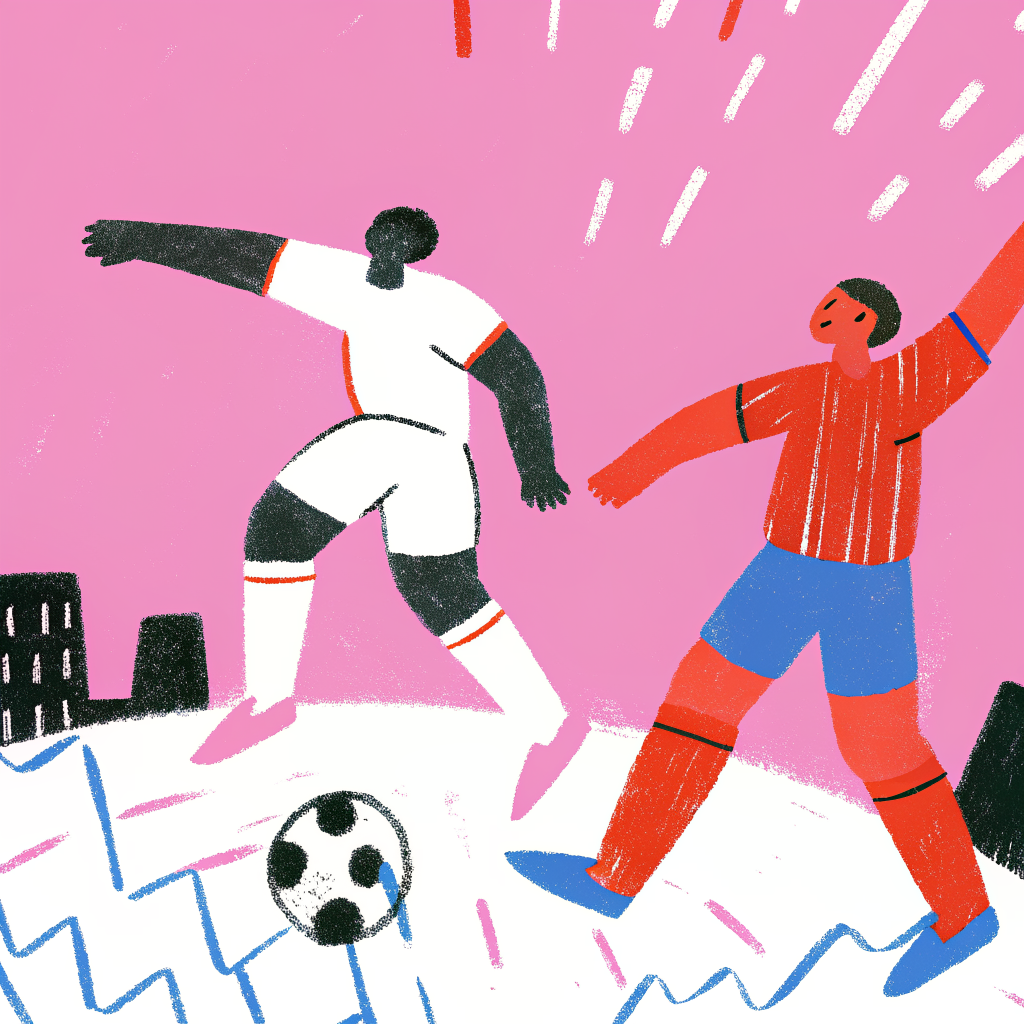
While the Bay Area obsesses over the World Cup's economic legacy and the departure of its professional teams, a quiet infrastructure has been growing for years: the Bay Area Adult Soccer League, a 100-team, 1,500-player Sunday league that runs on promotion and relegation, three referees per match, and the simple desire to play. This is the sports infrastructure that actually outlasts the mega-event — the local, the participatory, the thing that cannot leave.
The Reddit post sat there for days: "Looking to Create New Bay Area Adult Soccer League (BAASL) Team." It was tagged to r/oakland, buried under threads about rent control and the best burrito spots. No replies. The person who posted it wanted something simple — a squad, a field, a Sunday afternoon. They were looking for community in a region that has spent the last decade watching its professional teams leave.
I've been thinking about that post while the World Cup plays out at Levi's Stadium. The tournament is a spectacle — eight figures in infrastructure, global broadcast rights, the Arab diaspora turning the parking lot into a wedding reception, the whole Bay Area Host Committee machine angling to become a permanent sports commission. The legacy talk is thick. What does this mean for the region? How do we capitalize? What comes after?
The answer might already be here, running on a spreadsheet maintained by one woman in Berkeley.
The Bay Area Adult Soccer League is not what you think. It is not a ragtag pickup operation. It is not a few friends kicking around a ball on a patch of grass. BAASL, founded in 2013 and directed by Irene Reyes, fields over 100 teams across men's, women's, and co-ed divisions. More than 1,500 adults play every week. They play 5v5, 8v8, and full 11v11 matches at Tom Bates Sports Complex in Berkeley, Crocker Amazon in San Francisco, Rumrill Sports Complex in San Pablo, Orinda Wilder. The league has promotion and relegation. First place moves up; last place moves down. Eleven-a-side matches get three referees — a standard most recreational leagues never bother with.
The level of play is described by players as "a great balance between social and competitive." That is the exact sweet spot where sports actually live. Not the elite tier where you are paid and your body is a commodity. Not the pickup tier where you show up when you feel like it and nobody keeps score. The middle ground where you pay a fee, you show up every Sunday, you care about the table, you care about your teammates, and you go out for beers afterward.
This is the infrastructure that outlasts the mega-event.
The World Cup will leave. The cameras will pack up. The Bay Area Host Committee will either succeed in its bid to become a permanent sports leadership commission or it won't. Levi's Stadium will go back to hosting 49ers games and Taylor Swift concerts. The legacy question is what remains when the global spotlight turns elsewhere.
The level of play is described by players as "a great balance between social and competitive."
What remains is a league that was already here, growing quietly, long before FIFA arrived. BAASL has no official connection to the World Cup. No partnership, no infrastructure investment, no pipeline program. The league's players talk about the tournament with excitement — "the future of soccer continues to flourish here in the US," one told the league blog — but the connection is aspirational, not structural.
And that is fine. Maybe that is better. The real legacy is not a stadium that gets used once every four years. It is the Sunday league that keeps running because people want to play.
I keep thinking about that Reddit poster. The silence on their thread is not a judgment on the idea. It is a symptom of how we talk about sports in this region. We obsess over the professional departure — the A's gone to Sacramento, the Warriors across the Bay, the Raiders long gone to Las Vegas. We mourn the loss. We argue about what the city owes us. We stake our identity on teams that are ultimately businesses, free to leave whenever the math stops working.
But the Sunday league does not leave. The field at Crocker Amazon is not going to relocate to Las Vegas. Irene Reyes is not going to take the promotion and relegation system to a better market. The 1,500 players who show up every week are not going to be bought out by a hedge fund.
This is the sports infrastructure that actually matters. It is the infrastructure that belongs to the people who use it. It is the infrastructure that survives because it is built on desire, not on revenue projections.
The World Cup is a beautiful thing. I have watched matches at Levi's this week, felt the energy, seen the way the tournament brings together communities that rarely overlap. But the tournament is also a reminder that sports at the highest level are increasingly divorced from the places that host them. The players are global mercenaries. The governing bodies are opaque bureaucracies. The economic benefits are overstated and unevenly distributed.
The Sunday league is the opposite. It is local. It is transparent. The benefits are obvious and immediate: you get to play soccer with your friends.
I hope the person who posted on Reddit finds their team. I hope they show up at Tom Bates or Crocker Amazon, put on their cleats, and run around for 90 minutes. I hope they finish mid-table and go out for beers. I hope they do it again next season.
The World Cup will be over soon. The Sunday league will still be here. That is the legacy worth having.
The Discussion
Sign in to join the discussion.
Loading…