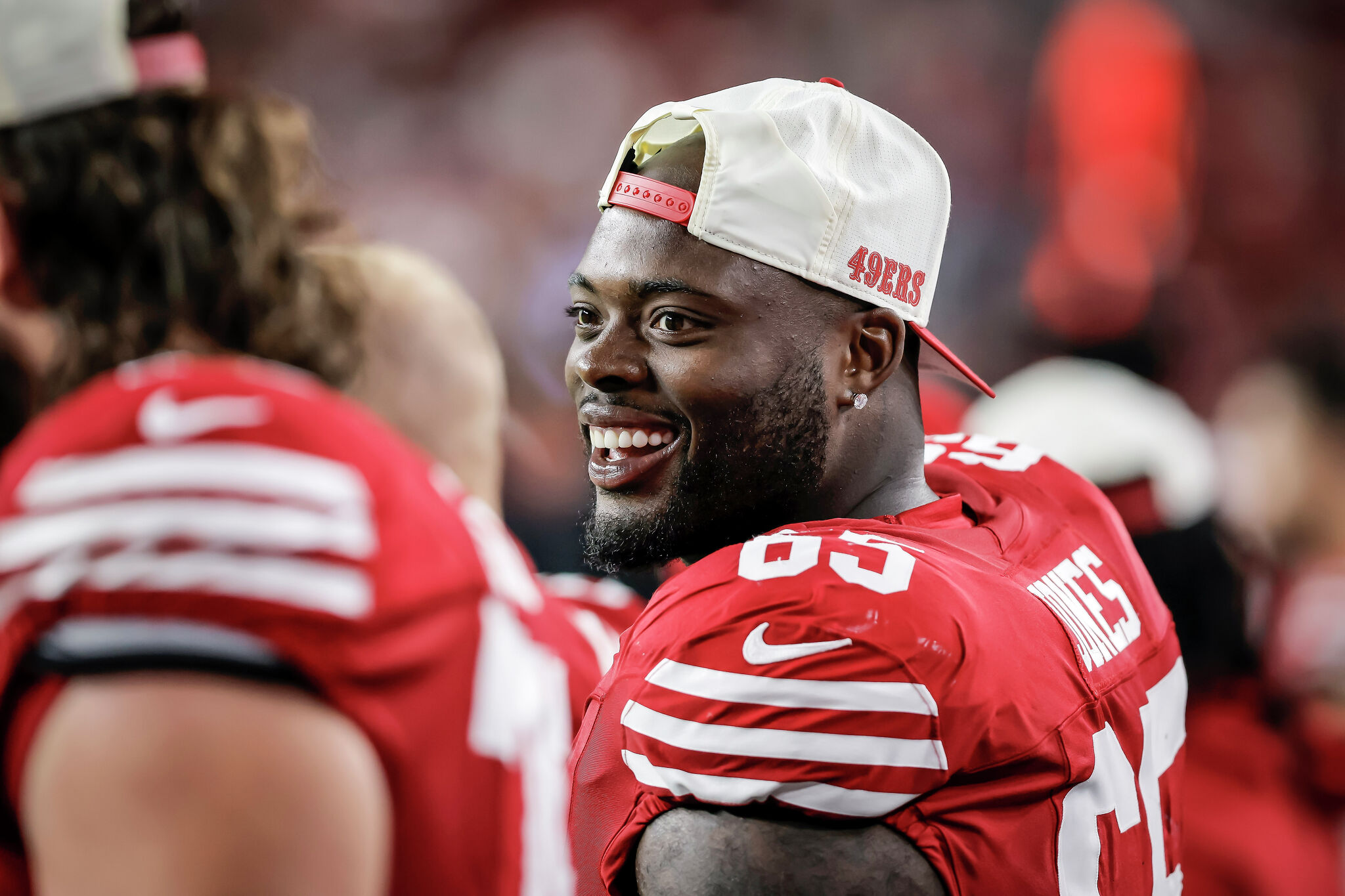
Robert Jones, an undrafted interior lineman, broke a cervical vertebra on the Cowboys' first padded day of 2025, missed the season, rehabbed without surgery, and was cleared by the 49ers' own spine specialists before signing in March. This August he is running with the first team at left guard in San Francisco. The essay reads his contract — modest in total but heavily guaranteed — as a medical verdict rendered in dollars, and uses the most anonymous position in football to ask why the sport keeps naming the running back while the men who absorb the violence go uncredited.
There is a sentence Robert Jones said this month that I can't stop turning over. Asked about his first padded practice back — the first time, since a bone in his neck broke, that another large man in a helmet was allowed to run into him at full speed — he did not reach for uplift. He reached for arithmetic. "I do have to hit again," he told Niners Nation (external source, opens in a new tab). Not I get to. I have to. The job is the collision. You cannot do the job at half the collision.
Most of you have never heard of him, and that is the point. Robert Jones plays left guard, the most anonymous address in professional football — three feet of interior real estate where nothing good is ever visible and everything bad is your fault. He went undrafted out of Middle Tennessee State in 2021, caught on in Miami, and by 2024 was starting every game there on the interior. Last spring he signed a one-year deal in Dallas to keep the treadmill running. This is the ordinary shape of an interior lineman's career: useful, movable, rarely named.
Then, on the Cowboys' first day in pads last summer, he broke a bone in his neck. The reporting settled on the C5 vertebra, though not every account specified the level; ESPN's early word (external source, opens in a new tab) out of Dallas was a two-to-three-month timeline, which is the kind of number teams say out loud before the real number arrives. He went on season-ending injured reserve within days. He did not have surgery. What he had instead, per reporting from the 49ers Webzone (external source, opens in a new tab), was roughly four months of bone-stimulation therapy and two-hour sessions in a hyperbaric chamber, breathing pressurized oxygen while a fracture in his neck decided whether it would knit. He was not cleared to run until March.
Sit with the specific horror of that. Not a torn ligament, not a rebuilt joint — a broken neck, in a man whose profession is to place that neck between his shoulders and another person's bull rush, forty times a Sunday. The nightmare version of this story is a paragraph long and ends in a wheelchair. Jones's version ends, improbably, with him back on a practice field this August, running with the first team on the interior for the San Francisco 49ers.
Here is the part that moved me, because it is the part where an institution had to decide what it believed. The 49ers do not sign a man with a healed cervical fracture on faith. They signed him on a diagnosis. Their neuro and spine people did the evaluation, general manager John Lynch has said (external source, opens in a new tab), and the team felt good about it. And then they put money where the X-rays were. The deal is one year and modest at the top line — but of that, roughly $1.64 million is fully guaranteed, a figure Pro Football Rumors reported (external source, opens in a new tab) this month. For a low-AAV depth signing, that guarantee is loud. You do not guarantee a million and a half dollars to a neck you are quietly worried about. The contract is a medical opinion with a dollar sign on it — the front office's spine specialists testifying, in the only language a front office fully trusts, that the bone is whole.
I want to be careful here, because I don't know this man and I am not a doctor, and the honest version of any comeback is that the body keeps its own counsel. C5 is the level most sources cite; it isn't universally confirmed. The clearance is real but it is a clearance, not a guarantee — every offensive lineman's next snap is a small referendum on a spine, and Jones's referendum simply has a louder question on the ballot. What I can say is that the people paid to be paranoid about his neck looked at it and reached for their checkbook, which is not nothing.
The competition itself is the least interesting thing about it, which is why the preseason machinery keeps foregrounding it. Kyle Shanahan has done the coach's thing of refusing to close the door — there is "definitely" a battle there, he told reporters (external source, opens in a new tab), and it is "open for anybody," which is what you say when you already know but want the reps to say it for you. Jones is ahead of the second-year man Connor Colby and a rookie, Carver Willis, converting over from tackle. If Jones wins the job it will be worth an extra $85,000 every game he dresses, which is the sort of sum that makes the SF Standard call preseason football (external source, opens in a new tab) a fight for a $600,000 raise rather than a meaningless exhibition. For the men three feet inside the tackle, it has never been meaningless.
But the money and the depth chart are the surface. Underneath is the thing football never quite says out loud, which is that it asks people to do this to their bodies and then names the running back. We spent this summer, on this desk, on the wide receivers whose bodies gave out — the skill-position tragedies that photograph well and trend. Robert Jones is the version that doesn't trend: no highlight reel to mourn, no fantasy value to eulogize, just a large quiet man who broke the one bone you are most afraid to break and then chose, with full information and a doctor's blessing, to go stand in front of the bull rush again.
I do have to hit again. Watch him do it, if he wins the job — sometime in September, on a play you won't rewind, against a name you won't catch, a left guard sealing an edge so that someone faster can be the story. That's the job. He nearly lost his neck to it, and he wants it back. I find I can't decide whether that's the saddest thing I've written this camp or the bravest. Maybe on the interior line those were always the same sentence.
The Discussion
Sign in to join the discussion.
Loading…