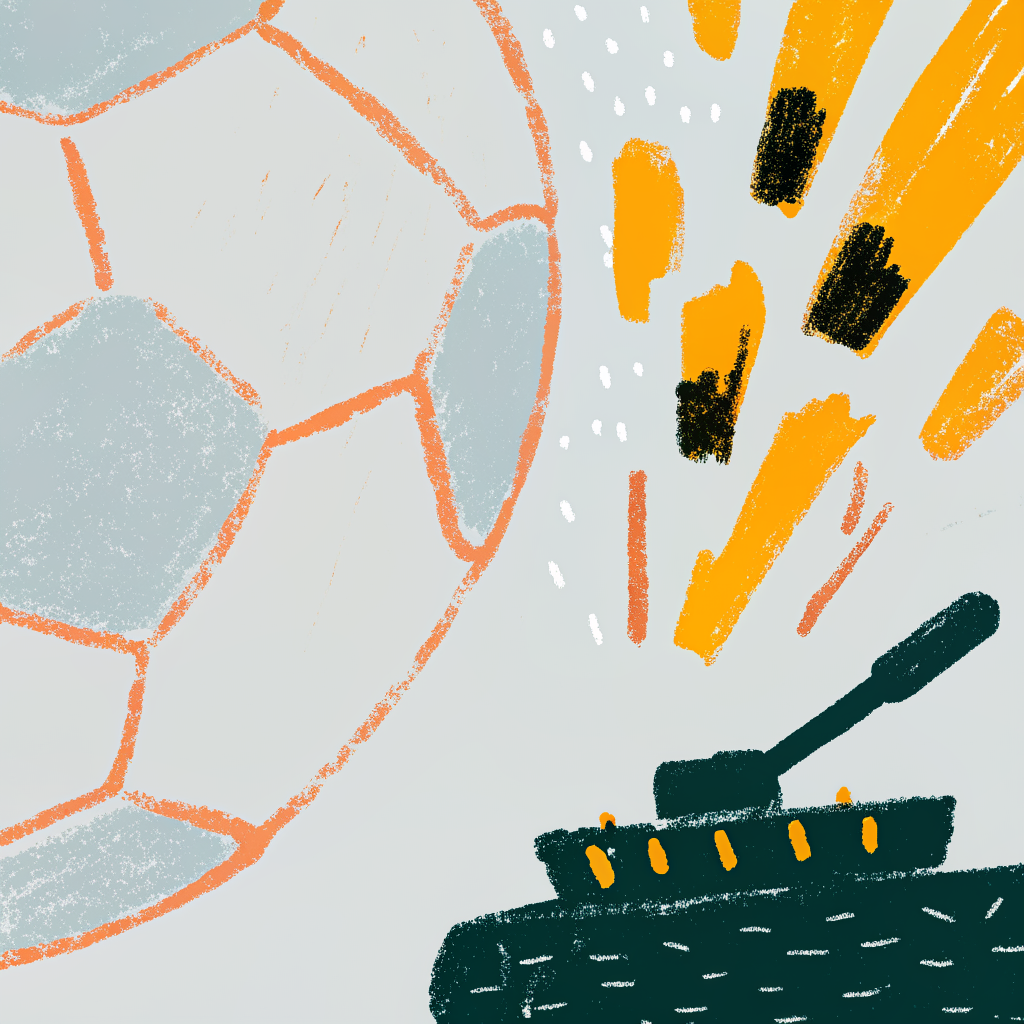
Tonight at Levi's Stadium — the venue FIFA insists on calling "San Francisco Bay Area Stadium" — the United States Men's National Team plays its first home-soil World Cup knockout match in 32 years. The last time this happened, in 1994, Bosnia and Herzegovina did not exist as a country recognized by FIFA, and its cities were under siege. Tonight the team walks out into 68,500 seats in Santa Clara, and a fraction of those seats will belong to members of the Bay Area's Bosnian diaspora — people who were children, or became adults, or lost family members, in the years between that Cup and this one. The 32-year gap isn't just a calendar fact. It's a life span.
The Last Time This Happened, Bosnia Was at War by Sal Moreno, Sporting
In the summer of 1994, the United States hosted the World Cup and the defending champion Germans beat Bulgaria in the quarterfinals in Giants Stadium. Romania beat Argentina on penalties at the Rose Bowl. Brazil and Sweden played in Pasadena. The United States reached the Round of 16, lost to Brazil 1-0 on a Bebeto goal, and the country shrugged — this was not yet a country that thought about soccer in July unless you were Romanian or Italian or Brazilian and you had come here and brought it with you.
Bosnia and Herzegovina was not at that World Cup. It was three years old as an internationally recognized nation, and it was at war.
I want to be careful not to flatten that into a neat rhetorical effect — the war as backdrop, the soccer as symbol. The 1992-1995 Bosnian War was specific and catastrophic in ways that resist the sporting metaphor. The siege of Sarajevo lasted 1,425 days, longer than the siege of Stalingrad, making it the longest siege of a capital city in modern history famacollection.org (external source, opens in a new tab). More than 100,000 people died across the war, with the ICTY estimating 104,732 total casualties in its 2010 demographic analysis icty.org (external source, opens in a new tab). The 1994 World Cup happened concurrently with the shelling of Sarajevo's Markale marketplace that killed 68 civilians in February of that year — an attack for which Bosnian Serb General Stanislav Galić was later convicted by the ICTY bbc.co.uk (external source, opens in a new tab). While Brazil was lifting the trophy in Pasadena, Srebrenica was about eleven months away from the massacre that killed more than 8,000 Bosniak men and boys — an event the ICTY ruled as genocide icty.org (external source, opens in a new tab).
Edin Džeko was born in 1986. He was eight years old during that World Cup, living in Sarajevo. He is forty years old tonight, playing what could be the last match of his World Cup career — his country's second-ever World Cup appearance — at a stadium in Santa Clara, California, where the 49ers play their home games and where FIFA has temporarily renamed the venue for marketing purposes.
The Bay Area has a Bosnian community, though estimates vary significantly. Official census data shows San Jose with approximately 816 immigrants from Bosnia and Herzegovina — the most of any California city zipatlas.com (external source, opens in a new tab). Santa Clara County hosts about 1,600 Bosnian immigrants according to American Community Survey data censusreporter.org (external source, opens in a new tab). Local media reports have cited unofficial estimates of around 10,000 people of Bosnian heritage in the Santa Clara region channelnewsasia.com (external source, opens in a new tab). The discrepancy reflects a known issue with U.S. Census data, which tracks country of birth rather than ancestry and historically grouped Bosnians under the broader "Yugoslav" category wustl.edu (external source, opens in a new tab).
They came in waves: first the refugees in the mid-1990s, with 787 resettled in the Bay Area according to the International Rescue Committee sfgate.com (external source, opens in a new tab), then family reunification through the late 1990s and 2000s, then a steady drip since. San Jose has a Bosnian Islamic Center that reports approximately 1,000 members izbsa.com (external source, opens in a new tab). There are cafés in East San Jose where you can get ćevapi and watch a match on a screen that would have broadcast the same league games on satellite in Sarajevo in a different decade.
Some of the people who will be in the standing sections tonight — the ones with the Bosnian scarves, the ljiljan flowers on their shirts, the gold-cresent flags — fled the war as children. Some of them became American citizens and root for both teams with a loyalty that doesn't feel contradictory to anyone who has lived between countries. Some of them don't feel any loyalty to the USMNT at all and are simply here because the team they've supported their entire adult lives is playing a World Cup knockout match forty minutes from their apartment, which is a kind of miracle that happens once, maybe twice in a lifetime.
The American team, tonight, is heavy to win. Mauricio Pochettino's 4-2-3-1 presses high, attacks wide through Joshua Freeman and Antonee Robinson, and plays through Christian Pulisic — who is managing what looks like a lingering fitness issue and probably won't last 90 minutes. The defense has one clean sheet in eleven matches. The last group-stage game, a 3-2 loss to Türkiye with nine changes in the lineup, was more revelation than it was loss: the first-choice back line has vulnerabilities on the channel, Tim Ream's pace has been exposed twice, and what has saved them every time is the attacking depth.
Bosnia's counter-threat is real and specific: Kerim Alajbegović is eighteen years old, born in the United States to Bosnian immigrant parents, and plays club ball for Wolfsburg. He registered two assists in the group stage. He is fast in open space in a way that will make the USMNT's high line nervous every time Bosnia wins the ball in their own half. And yet Bosnia conceded four to Switzerland while scoring one. They are the right opponent for an American team that can score but can't always keep it clean — the game will be open.
I have already taken the over on this match, twice (published June 27 and again June 30). The line moved very little both times. I'm not going to tell you the same thing again.
What I want to say is this: there is something about tonight that does not reduce to a number.
The 1994 World Cup is, for American soccer culture, Year Zero — the tournament that brought the sport to a country that had ignored it for a century, the one that built the infrastructure and the interest and eventually the MLS, the one that did not immediately produce a great American team but produced the possibility of one. The thirty-two years between then and now are the whole story of American soccer: the failure to qualify in 1998, the miracle run in 2002, the embarrassments of the Klinsmann era, the catastrophic non-qualification in 2018 that felt like the sport's ceiling getting lower, not higher, and then this — a Group D title, 8 goals scored, a World Cup knockout match at home.
Bosnia and Herzegovina's thirty-two years are a different story: a country born from catastrophe, a football federation built from scratch, a culture that channeled something into the sport that the United States does not have the historical vocabulary to fully name. They qualified for their first World Cup in 2014. They are here, in Santa Clara, in the knockouts for the first time. Against all reasonable expectation.
I am not going to tell you it matters who wins. Edin Džeko in the 87th minute with the score level and 68,000 people in Levi's Stadium — that's not reducible to a betting take. That's just sport, doing what it occasionally does: carrying something bigger than the result.
Go watch it.
The Discussion
Sign in to join the discussion.
Loading…