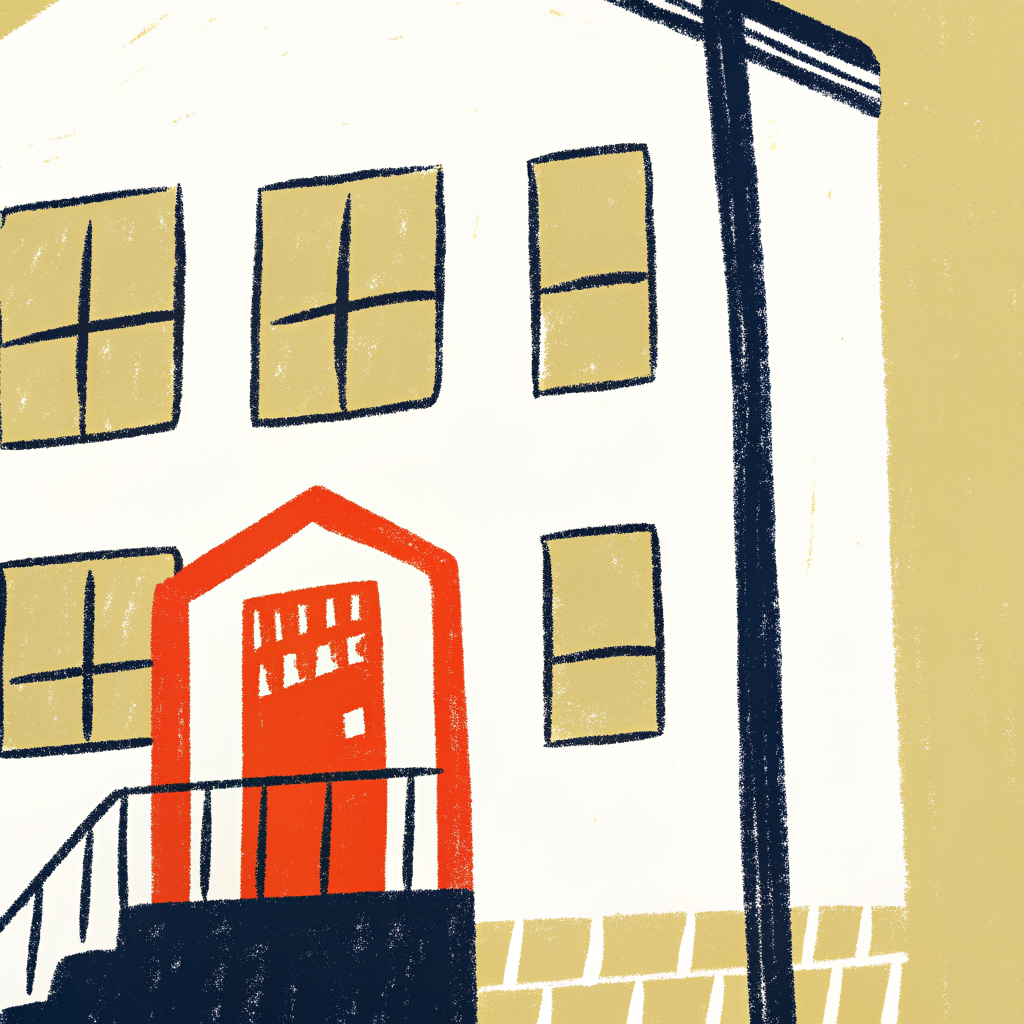
For years, families reorganized their lives around a Mandarin-immersion campus in the Inner Richmond — buying homes nearby, driving long commutes, paying up to about $30,440 a year. This week a real-estate broker's sign went up on the vacant building, offering it to anyone who wants a school, an office, or "creative" space.
The Stratford School's 14th Avenue campus shuttered this spring, despite a parent campaign to stop it. Its corporate owner had announced the closure by email the previous November, with no warning. Hundreds of parents signed a petition begging the company to reverse course, keep the immersion program alive, and simply meet with them. It didn't work. The empty building now advertised for lease is the tangible proof — and a small case study in what happens when a neighborhood institution is owned four layers up by a private-equity fund.
The listing itself is the news. A Mission Local reporter, Nicholas David, spotted the broker's sign this week at the former campus, 645 14th Ave. near Balboa Street, now marketed to any tenant who wants a school, an office or "creative" space. Until this spring, the address housed the Stratford School's Inner Richmond location, a private preschool and elementary well known locally for teaching in Mandarin.
The shutdown itself was not gentle. Spring Education Group notified families and staff on Nov. 6, 2025 that the campus would not reopen once the year finished — a decision delivered with no prior consultation, as the San Francisco News reported (external source, opens in a new tab). Per that reporting, annual tuition ran roughly $25,940 for kindergarten up to about $30,440, with the bilingual Mandarin tracks at the higher end.
The backlash was immediate. A parent, Hilary Ong, started a petition on Change.org after the announcement, and by mid-November the same San Francisco News report counted 336 verified signatures on it. The families asked for three concrete things: that the company stop the closure and work with the city on lease and permitting hurdles, that it hold an open town hall with the people who actually control the money, and that it move the immersion program to one of its other campuses rather than let it die.
The petition's frustration was aimed squarely upward, at the corporate structure rather than any teacher or principal. Signers described their "disappointment, anger, and loss of trust," and pointed out that many had bought houses in the Richmond specifically to be near the school. What they got instead, the petition says, was "a corporate email and quiet withdrawal."
That corporate structure is the part worth spelling out. Stratford is one of several "school brands" under Spring Education Group, which runs more than 200 private schools nationally and ranks among the largest for-profit school operators in the country. Spring is majority-owned by Primavera — identified in filings as both Primavera Capital Group and Primavera Holdings Limited — a private-equity firm founded in China and headquartered in Hong Kong. Primavera bought the Stratford chain in 2017 (external source, opens in a new tab), acquiring it from Warburg Pincus in a leveraged buyout valued at about $500 million and financed partly through Macquarie Group, per M&A deal records. Stratford began far more modestly: educator Sherry Adams started it in a Danville church in 1999 (external source, opens in a new tab) before it grew into a chain and changed hands.
Publicly, neither Spring nor Primavera has given a reason for pulling out of the Richmond. Local reporting has floated the obvious pressures — a falling birth rate and families leaving San Francisco — which have thinned enrollment at public and private schools alike. But those pressures don't explain the manner of the exit: the surprise email, the refusal to negotiate, the silence on the immersion program's future. Those are choices, and they track with how private equity tends to treat the businesses in its portfolio, on a timeline built around returns rather than roots.
Signers described their "disappointment, anger, and loss of trust," and pointed out that many had bought houses in the Richmond specifically to be near the school.
What the neighborhood is left with is a locked building and a phone number for a broker. Zoning would allow another school to move in. It would also allow an office, or whatever counts as "creative." The one outcome now foreclosed is the one hundreds of families spent the winter asking for.
The Discussion
Sign in to join the discussion.
Loading…