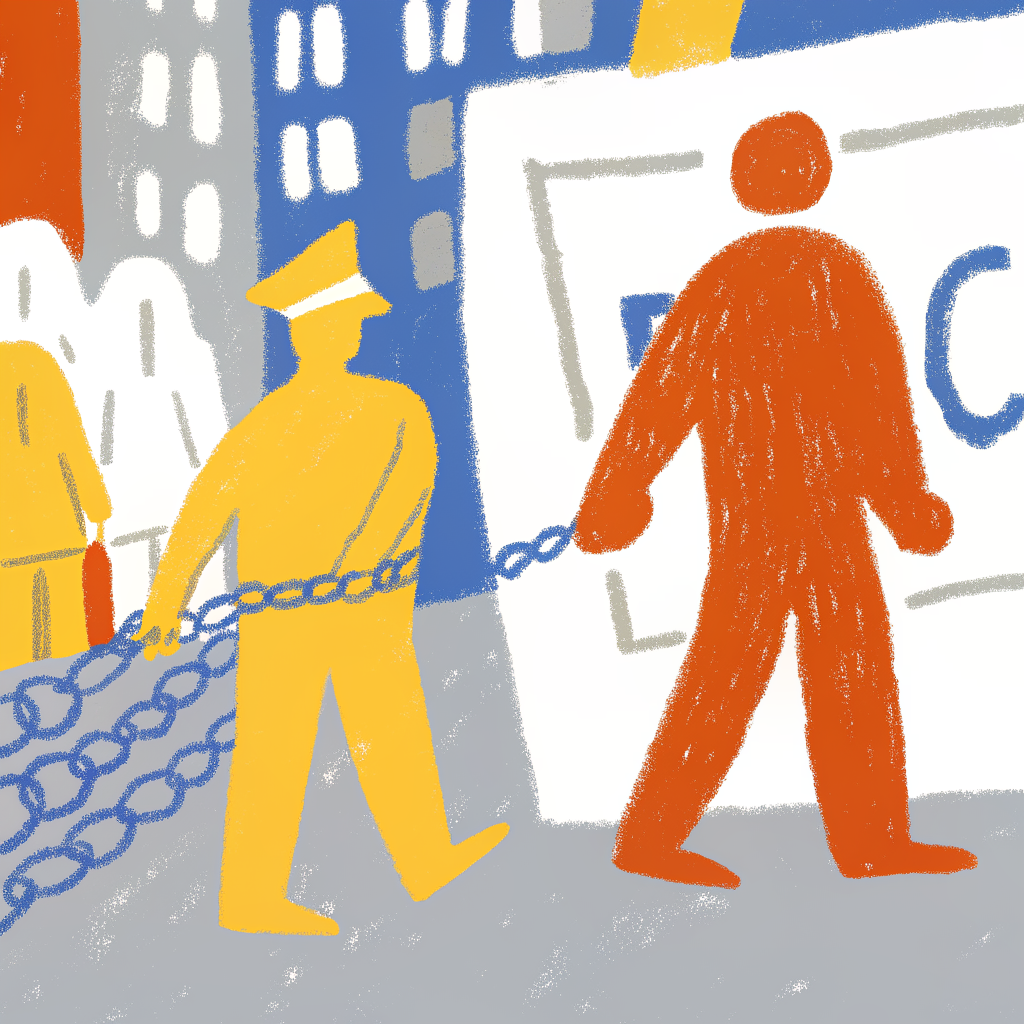
San Francisco police spent four days tailing Gregory C. Morton before arresting him for the March killing of 24-year-old Tertron Johnson. He spent one night in jail. By Friday morning, the district attorney had declined to charge him and Morton walked free — a warrant-to-no-charge reversal that a police source called uncommon.
Last week's Bay Area wire coverage stopped at the arrest, presenting it as a case closed. The more revealing development came next: prosecutors who had signed off on an arrest warrant concluded, within the two-day booking window, that they could not exclude a self-defense claim, and released the man police had surveilled from Oakland into San Francisco. Johnson, killed at a Sunnydale block party where friends were filming a music video, still has no one charged in his death.
On March 24 at 10:43 p.m., officers responded to gunfire on the 1800 block of Sunnydale Avenue and found Johnson with multiple gunshot wounds. He died at a hospital. As Mission Local reported (external source, opens in a new tab) days later, Johnson — known to friends as "Troop" — had been at a block party in the Sunnydale public housing complex, crowding in front of a camera to shoot a rap video while children bounced in an inflatable castle nearby. His killing, flagged at the time by SFist (external source, opens in a new tab), was one of a cluster of gun deaths in a year that had opened with a sharp jump from 2025's near-record low.
For nearly five months, no one was in custody. Then SFPD's homicide detail identified Morton, 32, as the suspect and obtained an arrest warrant. On Aug. 8, the department's Violence Reduction Team located him at an Oakland property, watched him for days, and followed him back into San Francisco, where he was detained, according to SFPD's own account (external source, opens in a new tab). He was booked into county jail on a murder charge. Bay Area outlets, including Patch (external source, opens in a new tab), carried the capture as a resolution — noting only that the department would not say whether Morton and Johnson knew each other.
It wasn't a resolution. On Friday, the district attorney's office declined to file charges and Morton, booked Wednesday evening and held overnight Thursday, was released, Mission Local's Marina Newman reported (external source, opens in a new tab). Prosecutors said they lacked the evidence to disprove, to a jury's satisfaction, that Morton had acted to protect himself or someone else, and left the door open to revisiting the case if new evidence surfaced.
The reversal turns on a gap between two legal standards. Police need only probable cause to make an arrest; prosecutors must believe they can win a conviction beyond a reasonable doubt. State law gives them roughly two days to charge and arraign a jailed suspect or release him. Because the warrant had been approved by both the DA's office and a judge, prosecutors clearly saw enough to charge at first — then reversed. A police source told Mission Local the sequence is unusual but not unheard of, and said investigators had likely counted on the arrest itself to surface more evidence, from Morton's home or from continued surveillance. SFPD says the investigation remains open and active.
There is a further wrinkle The Dissent could not independently resolve. Mission Local reported that someone sharing Morton's name and age had earlier been charged in the 2015 killings of two teenagers at an Excelsior playground, freed after six years in custody, and later charged with possessing a gun while on supervised release. Court records reviewed for this piece do not confirm the two are the same man, and neither SFPD nor the DA has publicly connected them; the detail should be treated as unverified pending confirmation.
What is not in dispute is the hole this leaves. Supervisor Shamann Walton, who represents the neighborhood, called the killing devastating against the backdrop of a multiyear homicide decline, and told Mission Local in March that losing a community member to violence is a tragedy felt citywide. His office said two neighborhood anti-violence groups — Young Community Developers, plus a street-violence intervention effort — were working to connect Johnson's family with victim services. Five months on, they are still waiting for a prosecution — and, for now, there isn't one.
The Discussion
Sign in to join the discussion.
Loading…