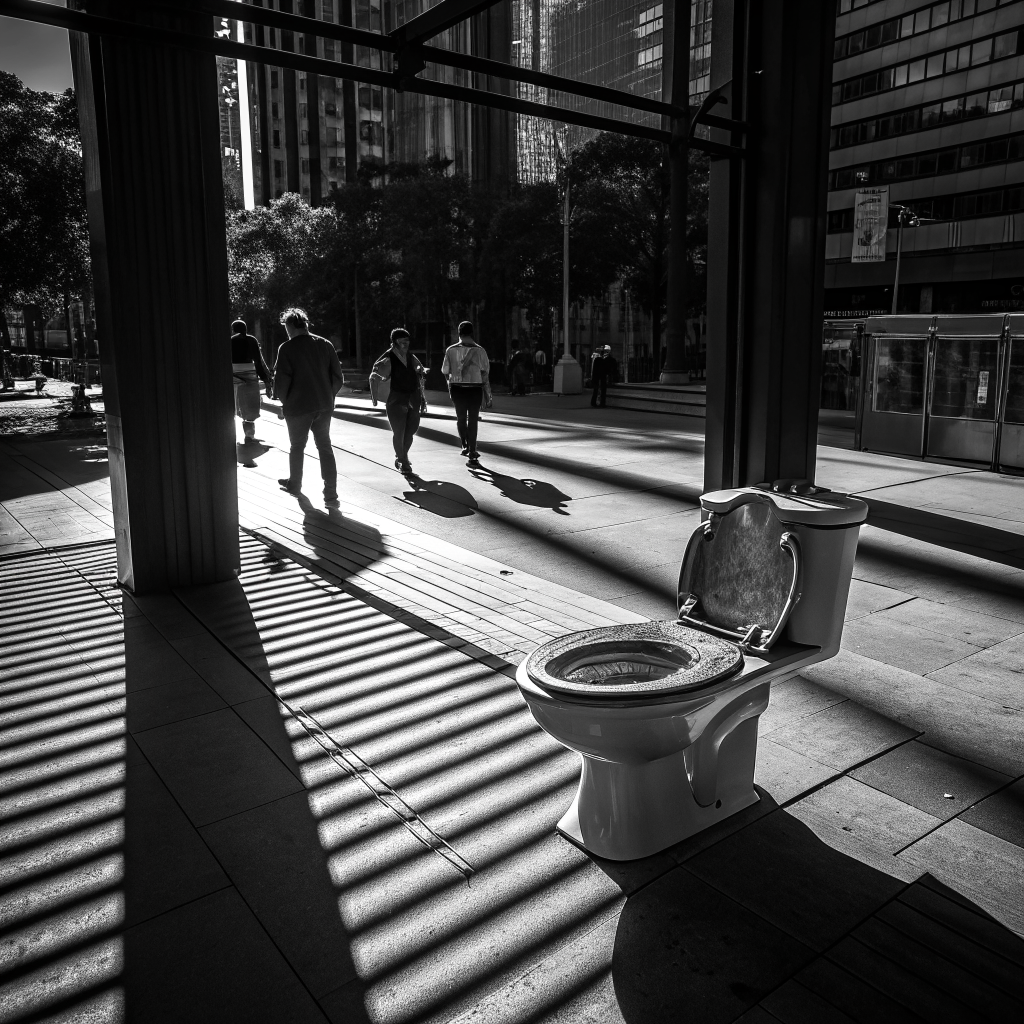
The gleaming stainless-steel toilet at Embarcadero Plaza that many pedestrians mistake for a sculpture was introduced in late 2022 as the flagship of a new generation of public restrooms — 25 in all, promised under a two-decade deal with a French advertising giant. Years later, the fleet has been slow to spread, even as the humbler toilets the city already runs face budget cuts.
The lone Embarcadero commode is the civic face of a bargain in which the public-service half has trailed the commercial half. Under its contract with JCDecaux, San Francisco pays nothing up front: the company recoups its money by selling ads on scores of new sidewalk columns, and in exchange maintains a promised set of automatic toilets. The columns are the revenue engine; the toilets are the amenity — and the amenity has proven harder to deliver, from a rocky debut to a public-toilet network now bracing for cuts.
Under the 2019 contract JCDecaux announced (external source, opens in a new tab), approved unanimously by the Board of Supervisors, the company agreed to design, install and maintain 25 fully accessible automatic public toilets alongside 114 three-panel advertising columns, 70 of them fitted with digital screens. The financing is the crux of the deal: the city is not billed for the hardware because JCDecaux earns its return from the advertising. The toilets, shaped by the local design firm SmithGroup, were meant to be the public-facing reward.
They arrived draped in acclaim. In a 2023 World Toilet Day announcement (external source, opens in a new tab), JCDecaux promoted the units — branded "AmeniPODS" — as prize winners in the year after the first was installed, citing honors from Metropolis, Fast Company and Metal Architecture. The company called public toilets "an indispensable service" and emphasized that the ads on its kiosks, not city dollars, pay for the program.
The reality on the sidewalk was less polished. The debut unit near the Ferry Building, meant to succeed JCDecaux's older, "chronically out of service" green kiosks, faltered almost immediately, as The Frisc recounted (external source, opens in a new tab) — going down within three days of its arrival, though that first outage ran only a couple of hours. The stumble fed a durable local frustration: a city that keeps landing in national coverage over its streets still can't reliably guarantee a working bathroom. Public Works spokesperson Rachel Gordon told the outlet the city cannot even tally how many public restrooms it has, because no single agency holds authority over all of them.
Years on, the shining fleet promised in 2019 has been slow to populate downtown — and the toilets the city does operate are under financial strain. This spring, The San Francisco Standard reported (external source, opens in a new tab) that the Department of Public Works' Pit Stop program — roughly 30 staffed toilets that recorded more than 750,000 visits over nine months — could see its budget slashed from $14 million to $5.7 million, threatening reduced hours, outright closures and layoffs among the formerly incarcerated attendants who monitor the stalls.
"There is a need for more units. This is a necessity, not an accessory," Pit Stop supervisor Paul Kaiwi told the Standard.
The contrast is the story. The advertising columns that bankroll the arrangement keep going up; the award-winning toilets they were supposed to fund remain thin on the ground; and the down-to-earth network that actually keeps people off the sidewalk is girding for cuts. Announcing the deal in 2019, JCDecaux co-CEO Jean-François Decaux pitched it as a way for cities to build infrastructure "in a fiscally responsible manner." The financing has held up as designed. The public payoff is still catching up.
The Discussion
Sign in to join the discussion.
Loading…