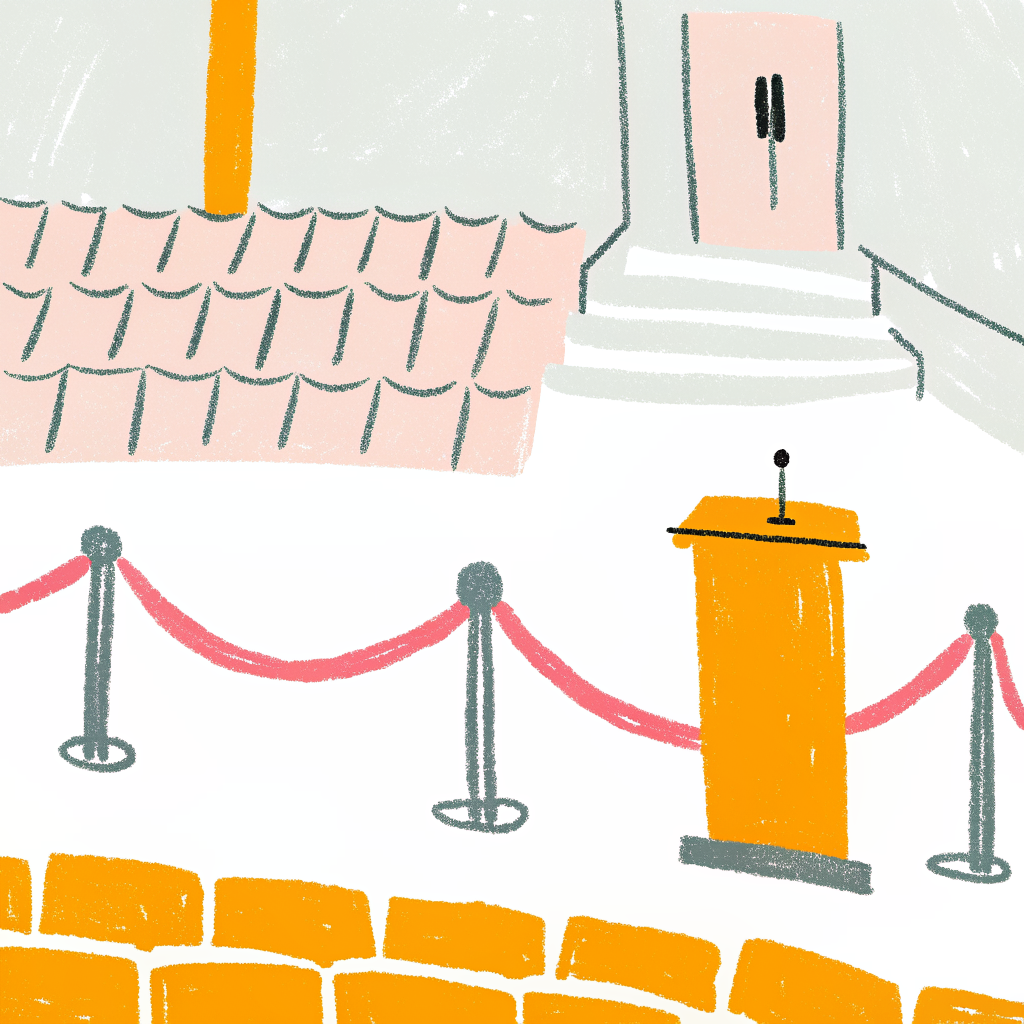
To watch Connie Chan and Scott Wiener debate for Nancy Pelosi's old House seat from inside KQED's Mission District headquarters on Oct. 1, most San Franciscans will pay $18. It is the second high-profile debate in this race to put a price on the door.
The Oct. 1 debate, a joint production of KQED and the San Francisco Chronicle, is the most consequential head-to-head yet in the contest to replace Pelosi after 39 years — and, like the March primary debate before it, admission to the room is not free for everyone. Organizers built an access ladder: a free livestream for all, a pool of free in-person seats for certain groups, and an $18 general-admission ticket for everyone else. That structure is now standard for the city's premier civic events, and it has prompted a plain question from voters — why charge anyone to sit in the audience of a candidate debate?
San Francisco's District 11 is about to choose its first new member of Congress since 1987. The two candidates are Democrats: Chan, a sitting city supervisor, and Wiener, a state senator. They take the stage at 7:30 p.m. Oct. 1 at The Commons, KQED's event space on Mariposa Street. Moderating are KQED's Marisa Lagos and Scott Shafer alongside Chronicle senior political writer Joe Garofoli. KQED plans to re-air the debate on its public radio signal Oct. 2 and on Channel 9 television Oct. 9, per the broadcaster's event listing (external source, opens in a new tab).
The stakes are the debate's billing. KQED's event listing (external source, opens in a new tab) frames the Oct. 1 matchup as a critical debate in the race to succeed Pelosi, who is retiring after 39 years in Congress, and names affordability, technology and the economy, immigration and foreign conflicts as the issues on the table.
Now the access ladder for the room itself. A general-admission seat runs $18. A capped number of free seats are set aside for three groups — people who hold a KQED membership, people who subscribe to the Chronicle, and students with an ID — using the code SFDEBATE26, the Chronicle told its readers (external source, opens in a new tab). And anyone at all can register to watch the livestream for nothing. Put plainly: the building is free to you if you pay one of the two host organizations for membership, or if you are a student — and if you are neither, the seat costs money.
That framing has drawn pushback from residents online, who argue that carving out free-ticket categories does not make a room universally accessible, and that who physically occupies a civic space — who applauds, who reacts, who lingers to approach a candidate afterward — is itself part of the event. Watching from home, the critique goes, is not the same as being there.
The hosts have not described the ticket as a barrier. KQED is a member-supported nonprofit, and ticketed programming through its KQED Live arm is a routine revenue and engagement stream; the Chronicle is a subscription business. Neither the charge nor the free tiers were presented as anything but ordinary event logistics.
What lifts the complaint above a one-off is the precedent. The March 31 primary debate — which put the two of them alongside former Justice Democrats co-founder Saikat Chakrabarti at the Sydney Goldstein Theater, staged by City Arts & Lectures, the Commonwealth Club, KQED and Manny's (external source, opens in a new tab) — was also a paid-ticket event. There, KQED said proceeds from ticket sales would support Vote.org voter-registration work, with free tickets set aside for students and educators. Both marquee debates in the race, then, have been run as ticketed productions rather than open public forums, with broadcast and livestream doing the work of universal access.
That is the trade-off on offer in the Chan-Wiener contest: the debate is free to watch from anywhere, and the seat in the room is not free for most. Whether that is a reasonable way to underwrite independent, professionally moderated political journalism, or an avoidable filter on who gets to be present for one of the city's most important political moments, is the argument now playing out ahead of Oct. 1.
The Discussion
Sign in to join the discussion.
Loading…