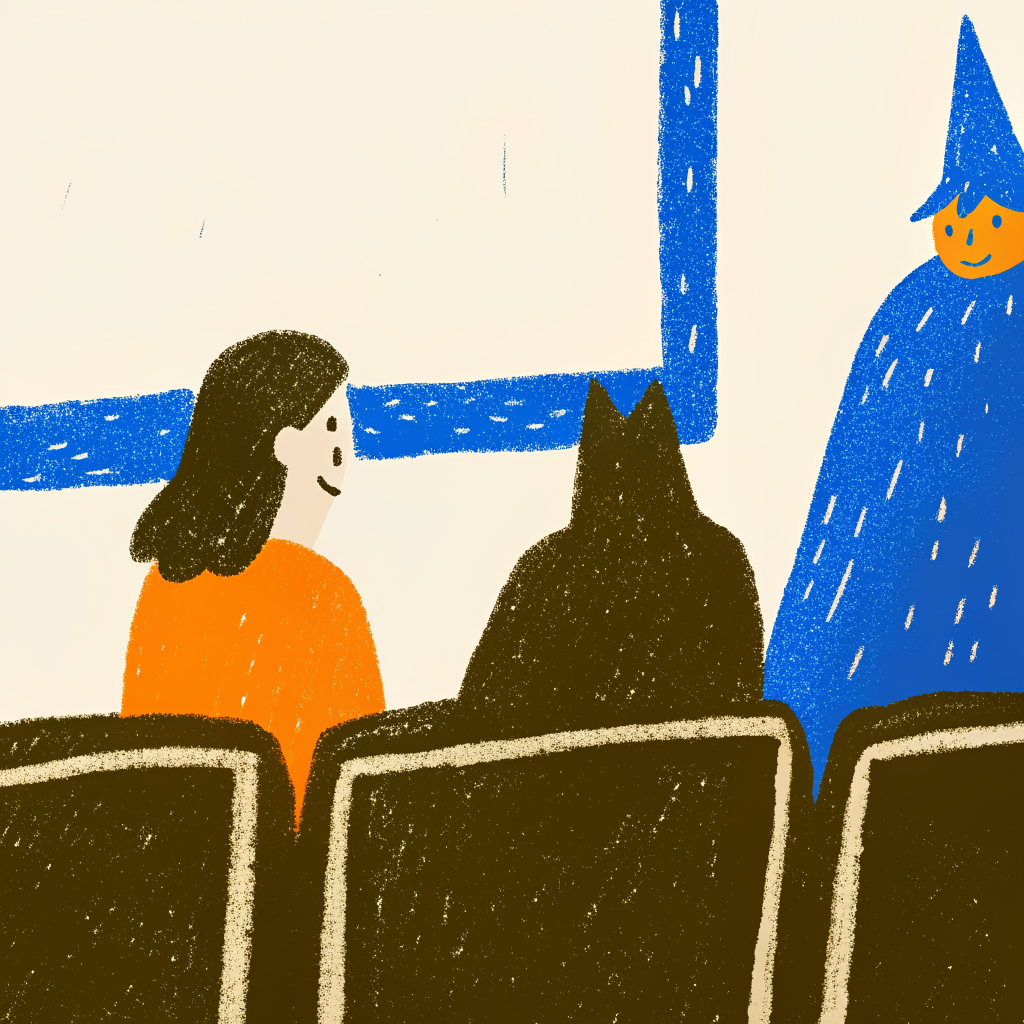
At the recent San Francisco Art Book Fair, local artist Aaron Wojack, whose official proposal was rejected, showed up anyway as his "Bat Witch Ghost" persona, adding an unscheduled dose of mischief to the 30,000-strong event, as reported by Mission Local and corroborated by SFGate.
On the 1200 block of Minnesota Street in the Dogpatch, the San Francisco Art Book Fair ran from July 23–26, drawing over 30,000 attendees to the Minnesota Street Project’s three-building complex at 1275, 1201 Minnesota Street, and 1150 25th Street. But beyond the official programming, a different kind of visitor made an appearance: the “Bat Witch Ghost,” a guerrilla performance by local artist Aaron Wojack, as extensively reported by Mission Local.
Wojack, the impresario behind the "Bat Witch Ghost" (an arts organization specializing in haunted houses, which previously mounted an immersive maze at Yerba Buena Center for the Arts, as reported by SFGate), had proposed a "haunted" exhibit complete with smoke machines and a zine-making workshop to fair organizers. However, as he told Mission Local, his concept was deemed too “haphazard” and not aligned with the “book” element of the fair. The rejection left him feeling "hurt" and "not appreciated by my own community," a sentiment he shared with Mission Local. Deciding that permission wasn't necessary for a true haunting, Wojack and his small crew of costumed actors took their performance to the fair unofficially.
The "Bat Witch Ghost" materialized not as a malevolent spirit, but as described by Mission Local through Wojack's own words, a "friendly ghost" with "good manners" but a mischievous streak that "loves to dance." This unsanctioned artistic intervention embodies a certain Bay Area irreverence.
Despite the unofficial nature of the performance, fair organizers appeared to embrace it. Gaelan McKeown, the director of the San Francisco Art Book Fair, told Mission Local that "We love the San Francisco ethos of just showing up and making it happen, because that’s what this was." This perspective highlights how the texture of a neighborhood's events is often shaped by its most unexpected participants. For those walking past the Minnesota Street Project this week, the memory of an unofficial, playfully haunting presence might linger longer than any official program.
The Discussion
Loading…