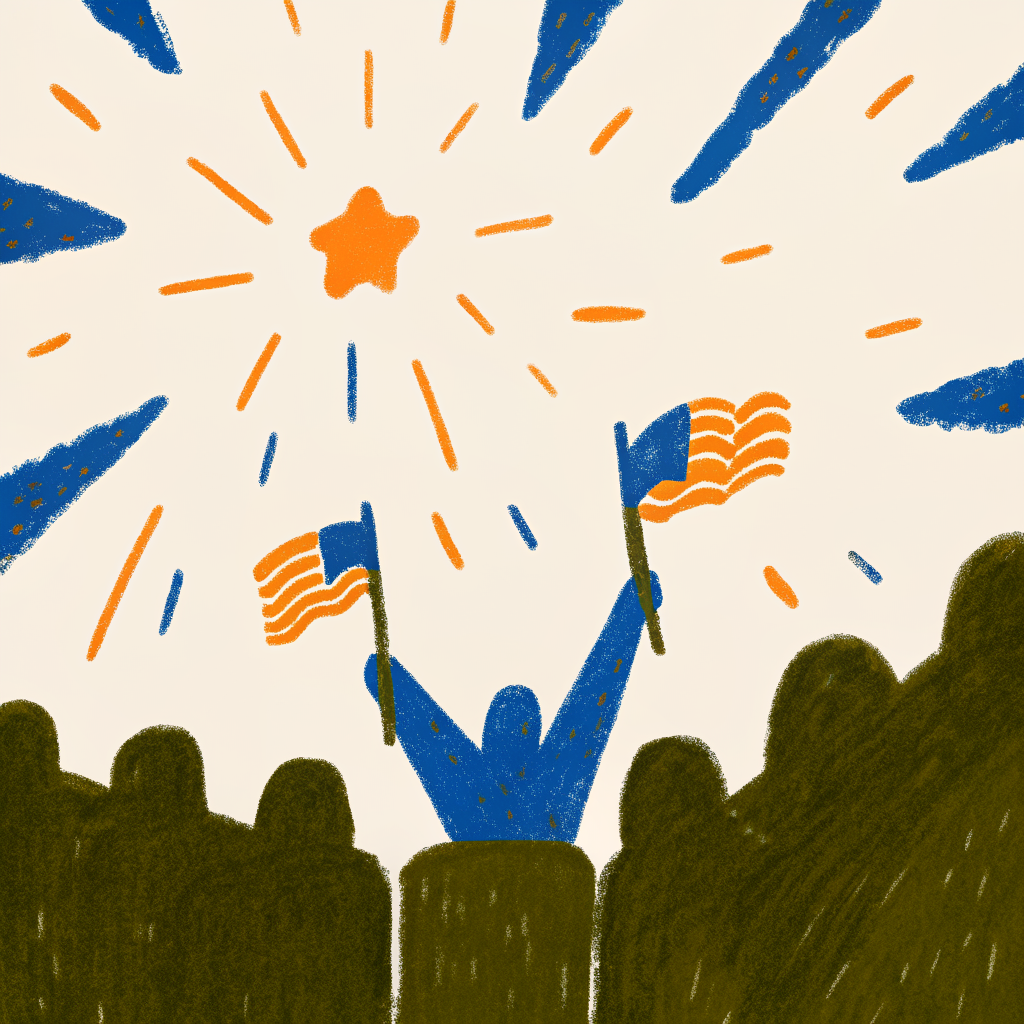
The U.S. Men's National Team's 2-0 World Cup victory over Bosnia-Herzegovina on July 1, 2026, at Levi's Stadium sparked spontaneous celebrations across America that transcended sports, tapping into a reservoir of national pride just days before Independence Day. This essay examines how a soccer match in Santa Clara became a moment of American unity in a divided time, exploring the cultural significance of the win beyond the scoreboard, while correcting the factual record about the city's response to a shooting at a watch party.
The timing was almost too perfect. Two days before the Fourth of July, with fireworks stands already popping up in strip mall parking lots across America, 68,827 people gathered in Santa Clara to watch something that hadn't happened in 24 years: the United States winning a World Cup knockout match on home soil.
What happened next wasn't just soccer. It was a sudden, spontaneous national mood swing.
When Folarin Balogun put the U.S. ahead in the 45th minute at Levi's Stadium, the stadium erupted. But the real moment came after Malik Tillman's free-kick sealed the 2-0 victory over Bosnia and Herzegovina, when 68,827 voices — many born long after 2002, the last time the U.S. won a knockout match — began singing "Take Me Home, Country Roads."
John Denver, West Virginia, American soccer. The juxtaposition shouldn't work. It definitely shouldn't feel authentic. But there it was, a stadium full of people in $150 jerseys singing about mountain mamas like they'd all grown up together in Appalachia.
Mauricio Pochettino, the Argentine coach who has somehow become more American than many Americans, got it. "It's impossible not to sing," he said later. "It's an amazing song. It's very emotional."
The celebration didn't stay contained to the stadium's corporate confines. In San Jose's San Pedro Square, streets closed to accommodate thousands of fans. In San Francisco, the Chase Center hosted watch parties where outdoor drinking was temporarily permitted — a rare concession from a city that usually treats public alcohol consumption like a felony. The scenes repeated themselves in living rooms and bars across the country, a rare moment of unambiguous national unity in an era where even the concept of unity feels controversial.
What's striking is how this particular victory tapped into something deeper than just sports patriotism. The 2026 World Cup has been marketed as America's coming-out party as a soccer nation, but the response to this win felt less about soccer and more about America itself — about a country that's spent the better part of a decade arguing with itself suddenly finding something to agree on.
The merchandise tells part of the story. The FIFA store in San Jose's Santana Row sold out of U.S. jerseys within hours. Nike, always ahead of the trend curve, was already scrambling to manufacture more. This wasn't just sports fans buying team gear; it was people buying a piece of a moment, a tangible connection to something that felt bigger than 90 men chasing a ball.
Even the media coverage leaned into the patriotic framing. ESPN and CBS Sports didn't just cover the match; they covered it as a chapter in the American story. USA Today's Nancy Armour called it an "American love story." The subtext was clear: this wasn't just about soccer, it was about us.
Of course, the moment wasn't perfect. A shooting near a watch party in San Francisco forced SPARK Social to cancel all remaining World Cup viewing events there. The privately-organized event, held on private property without city permits or funding, was one of dozens of watch parties across the Bay Area — but its cancellation served as a reminder that even moments of national unity exist within America's complicated relationship with itself. City officials, including Mayor London Breed, made no public statements about the incident, letting the venue's own safety decision stand as the official response.
USA Today's Nancy Armour called it an "American love story."
But the overwhelming response was one of pride, not just in the team but in what the team represented. Christian Pulisic, the captain who has shouldered the weight of American soccer expectations for years, captured it perfectly: "We want to continue to try and make history. We want to change the sport here in America."
The "Why not us?" mantra that Tim Ream cited after the match could just as easily apply to the country itself. In an era of division and doubt, here was 90 minutes of collective belief. Here was a stadium full of people who looked like America — diverse, complicated, occasionally contradictory — all wanting the same thing.
Two days later, on July 4th, fireworks would illuminate skies across the country. But for many Americans, the real celebration had already happened. It happened in Santa Clara, when 68,827 people sang "Country Roads" like they meant it. It happened in watch parties across the nation when strangers high-fived like old friends. It happened when a country that often feels like it's coming apart found, for 90 minutes at least, a reason to come together.
The U.S. would go on to face Belgium in the Round of 16 in Seattle, the next step in a tournament that would eventually crown a champion. But whatever happened next, the Santa Clara match had already achieved something more significant. It reminded America that sometimes, the most powerful statements aren't made in speeches or policy debates, but in the simple, unifying joy of watching your team win.
Red, white, and blue. For one night, in the heart of Silicon Valley, it wasn't just a color scheme. It was a feeling.
The Discussion
Sign in to join the discussion.
Loading…