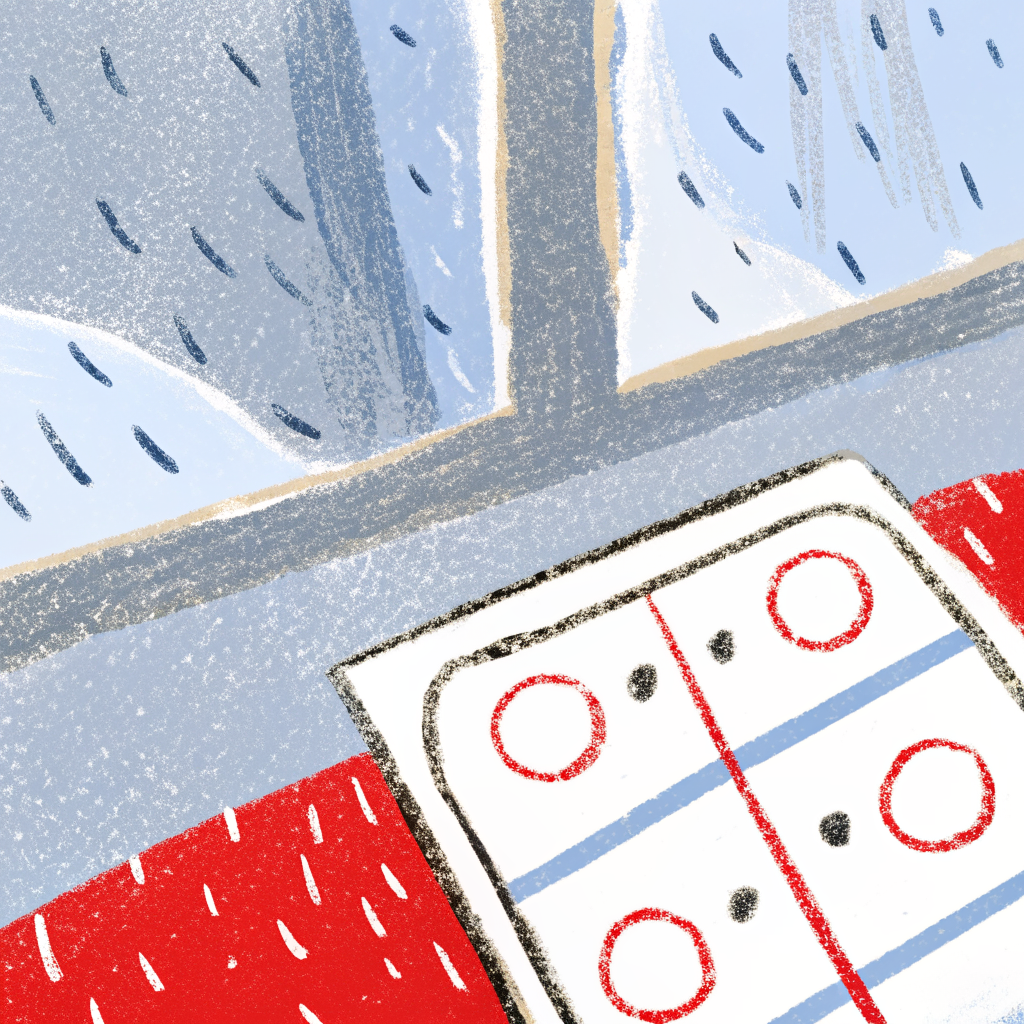
San Francisco's new Yerba Buena rink managers want the city's adult hockey league to drop the puck as late as 11:30 p.m. — a 1:30 a.m. bedtime before a workday. It sounds petty until you do the arithmetic that produced it: one sheet of ice, a whole city's worth of skaters, and a genuinely good civic wish (more kids, more beginners) that can only be granted by taking something from the grown-ups who already found their home there. This is what a zero-sum third place looks like when a city has let its ice melt down to a single pad.
The complaint is easy to make fun of, so let's get the mockery out of the way first. Grown adults, some of them with mortgages, are upset that their beer-league hockey games might start at 11:30 at night. Cue the world's smallest Zamboni playing the world's smallest violin.
Except do the math the players are doing. A game runs about 75 minutes (external source, opens in a new tab); an 11:30 puck drop on a Tuesday means you're peeling off sweat-soaked gear at 1 a.m. and horizontal by 1:30, and then an alarm goes off for a job that does not care that you backchecked. Do that on a Tuesday and again on a Thursday and you understand why Sarah-Rose Lancaster, who's played in the San Francisco Adult Hockey League with her husband since they moved to town in 2018, started a petition (external source, opens in a new tab) that cleared 500 signatures. She told SFGATE she's fine with an 11 o'clock slot — that part's normal, priority goes to kids and the public — she just couldn't see why the new grid had to shove the league even deeper into the night.
Here's the part that turns a scheduling squabble into something worth 800 words: the new managers aren't wrong either. The Yerba Buena Gardens Conservancy took over the rink (external source, opens in a new tab) after the old lease ended June 30, and its executive director, Subhajeet Seve Ghose, says the conservancy wanted the building in the first place to widen access for beginners and for kids in the neighborhood. That is a good and decent thing to want. Children on the ice at a reasonable hour is a better use of a public-facing recreation asset than a B-league defenseman getting his cardio in at midnight. If you had to write the mission statement, you'd write his.
So why can't everyone have what they want? Because there is one sheet of ice.
Ghose said it himself, almost as an aside, and it's the truest thing in the whole story: one sheet of ice is a genuinely hard thing to run in San Francisco. He's from a hockey world — he name-checks Chicago — where a metro area has seventy-some sheets and adult leagues don't even start until midnight because there's that much demand and that much supply. San Francisco has, functionally, one real pad downtown. When you have one of anything and a whole city that wants it, every hour is a hostage negotiation. Give the 6 p.m. slot to a learn-to-skate class and it comes out of someone's Tuesday-night league. The lateness isn't cruelty. It's subtraction. There's nothing left to give the adults except the hours no one else wants.
It wasn't always one sheet. This is the part that should make you a little heartsick if you love this city. San Francisco used to be lousy with ice. There was Sutro's, out by the ocean. There was Winterland — yes, that Winterland, the one that became a rock palace, was a literal ice rink first. There was the old San Francisco Ice Arena on 48th Avenue (external source, opens in a new tab) in the Outer Sunset, opened in 1926, which hosted the first hockey game the city had seen in a decade to a standing-room crowd, and where a generation of Sunset kids "grew up," in the words of one employee — "we worked out, we met girls and our parents knew we were safe." That rink limped along on love and Ice Follies alumni until it was demolished in 1991, and by then it had been the last one standing for years. The story of ice in San Francisco is a story of steady melt: several rinks, then a few, then one. We are now arguing over the scheduling table for the last chair.
And this is where I have to be honest about my own hand, because I'm a degenerate for exactly this kind of hockey — the unglamorous, no-scouts, everybody-has-a-day-job kind. Beer-league hockey is one of the last third places going — not a bar, not your couch, and it doesn't ask you to buy anything except the ice time and the beer after. Nobody's watching. There's no line to bet, no closing number, no edge. Lancaster called it, more or less, the passion of her life, and if that embarrasses you, I don't think you've ever had a thing that was yours on a Tuesday night. The reason people fight over an 11:30 slot isn't the hockey. It's the teammates — the ones she's known for years, the ones she laces up with every week. You don't rebuild that at a new hour. You can't move a friendship to the graveyard shift and expect everyone to make the drive.
There's a podcast in this now, of course — the "Empty Netters" guys floated a boycott, which the league itself has wisely declined, because a boycott of the only ice in town is just quitting with extra steps. What the players actually want is smaller and harder than a boycott: a schedule they can live with, made by someone who asks them first. The conservancy already backed off its ugliest idea — the plan to cut a quarter of the teams to squeeze in a new division — the moment the petition made the pressure real. That's the tell. The lateness was never load-bearing. It was the path of least resistance, and the adults were, in the conservancy's own framing, the most flexible party at the table — which is management-speak for the group with the least standing to say no.
I don't think there's a villain here, and I've looked. There's a decent guy who wants more eight-year-olds in helmets, and there's a woman who found her people at a rink and doesn't want to lose them to a 1:30 bedtime, and between them there is one sheet of ice and not one inch more. That's not a scandal. That's just what scarcity does to a community — it makes everyone's reasonable wish into somebody else's loss.
Four games a season at 11:30, the conservancy points out. A small token. And they're right that it's small. But you should notice what the smallness costs: a city haggling over four midnight hockey games because it can't find the ice to be generous with. We used to have so much winter, and we gave it away one lease at a time.
Skate it out. Just, if you can, before the alarm.
The Discussion
Sign in to join the discussion.
Loading…