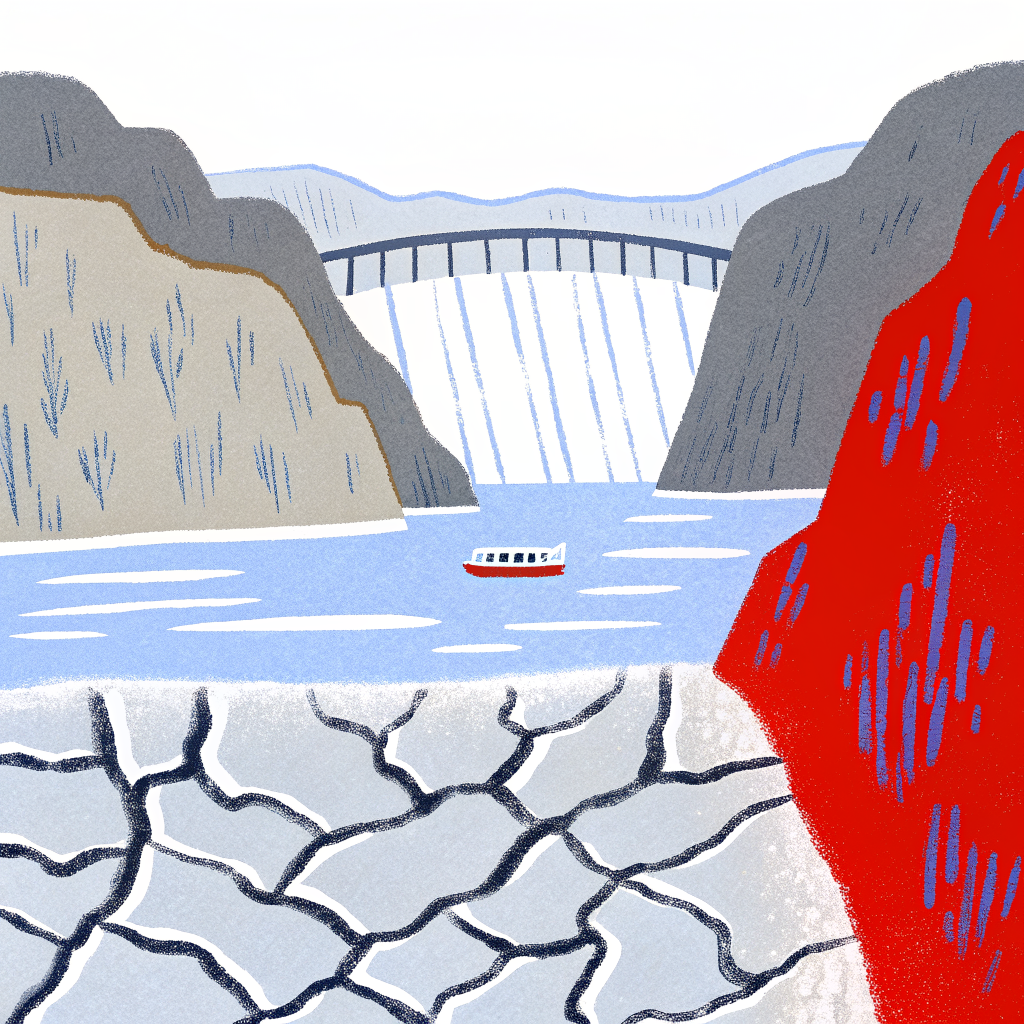
A record-setting drop at Lake Powell over the weekend put the Colorado River back in California headlines — and put a misconception back in circulation. San Francisco does not drink from that river. What the record low actually threatens is Southern California's supply and a seven-state truce that has already fallen apart.
The Bay Area's water is Sierra snowmelt, piped from the Tuolumne through the Hetch Hetchy system; the Colorado feeds Southern California and the desert farm belt, not the taps north of the Grapevine. So the milestone on the Arizona–Utah line is not a Bay Area shortage story. It is a Southern California one, stacked on top of a political failure: the states that share the river missed their deadline to agree on cuts, and a Trump-run Interior Department is now proposing to force Arizona, California and Nevada to slash use by about a fifth. California holds the river's largest single claim — the part of this a local reader should actually track.
Gauges on the reservoir bottomed out Sunday near 3,519.8 feet, a shade beneath the previous low from April 2023 and the deepest drawdown since Glen Canyon Dam first began impounding the river in the 1960s, per Bureau of Reclamation figures compiled by Colorado Politics. A year earlier, the surface had sat more than 30 feet higher.
That vanished 30 feet is, coincidentally, about all that stands between the dam and real trouble. Should the water reach an elevation of 3,490, the turbines inside Glen Canyon can no longer count on spinning; a further fall to 3,370 brings "dead pool," when nothing passes through the dam at all. Back in April, federal managers warned it would take a "major intervention" to keep the reservoir off the hydropower line by December, the Associated Press noted in an account carried by PBS NewsHour. Downstream, Lake Mead had already logged its own record low a week ahead of Powell.
Nobody who follows the river was caught off guard. "This was inevitable," said Eric Kuhn, who ran the Colorado River District before retiring, in remarks to Colorado Politics; the science, he added, had pointed this direction for 25 years. A grinding megadrought has shrunk the river's annual yield to something like 12 million acre-feet, far below the 15 million a 1922 compact still parcels out on paper. Those paper shares, in Kuhn's words: "It's talking nonsense when you're talking allotment that hasn't worked in decades."
Should the water reach an elevation of 3,490, the turbines inside Glen Canyon can no longer count on spinning; a further fall to 3,370 brings "dead pool," when nothing passes through the dam at all.
Where the water actually goes. San Francisco and roughly 2.7 million other Bay Area customers are served by the Hetch Hetchy Regional Water System, and the wholesale agency BAWSCA reckons about 85 percent of that supply originates in the Tuolumne River high in the Sierra. The Colorado is a separate ledger. California's 4.4-million-acre-foot entitlement to it is spent in the south — through the Metropolitan Water District and the Imperial Valley — and advocates at Restore Hetch Hetchy estimate the entire San Francisco regional system draws only about one-twentieth of that yearly figure. The pale ring around the rock at Page, Arizona, is not the rim of a San Francisco reservoir.
The electricity misses the Bay Area as well. Glen Canyon's low-cost power moves through the Western Area Power Administration to preference buyers scattered across Arizona, Utah, New Mexico, Colorado, Nevada, Wyoming and tribal utilities — a roster, WAPA's own materials show, that leaves out California's grid.
The part that should worry a Californian. It sits in the south, and in Washington. Metropolitan is on track to divert somewhere around 0.916 million acre-feet from the Colorado this year, and Interior's final blueprint, issued in late July, entertains trimming California's Colorado supply by roughly 10 percent through 2028 while directing the three Lower Basin states to give up close to 20 percent inside two years. The seven states were meant to author their own rules by Oct. 1. They didn't, and the task landed on Interior Secretary Doug Burgum, who has sat with the governors again and again and, as Colorado Politics summarized it, come away with nothing. Reclamation has had no confirmed executive director since 2025.
California's representative in those rooms, Colorado River Board of California chair J.B. Hamby, told PBS that the dangers gathering at Lake Mead touch some 30 million people — three-quarters of the basin's population. Anne Castle, until last year the chair of the Upper Colorado River Commission, named the deeper worry: that "we've used up our storage buffer and allowed the reservoir to get this low." For the Bay Area, then, the takeaway isn't the faucet. It's that a river most of us never drink from is quietly dictating the state's water politics — and that a stalemated federal government may be the one to finish writing the terms.
The Discussion
Sign in to join the discussion.
Loading…