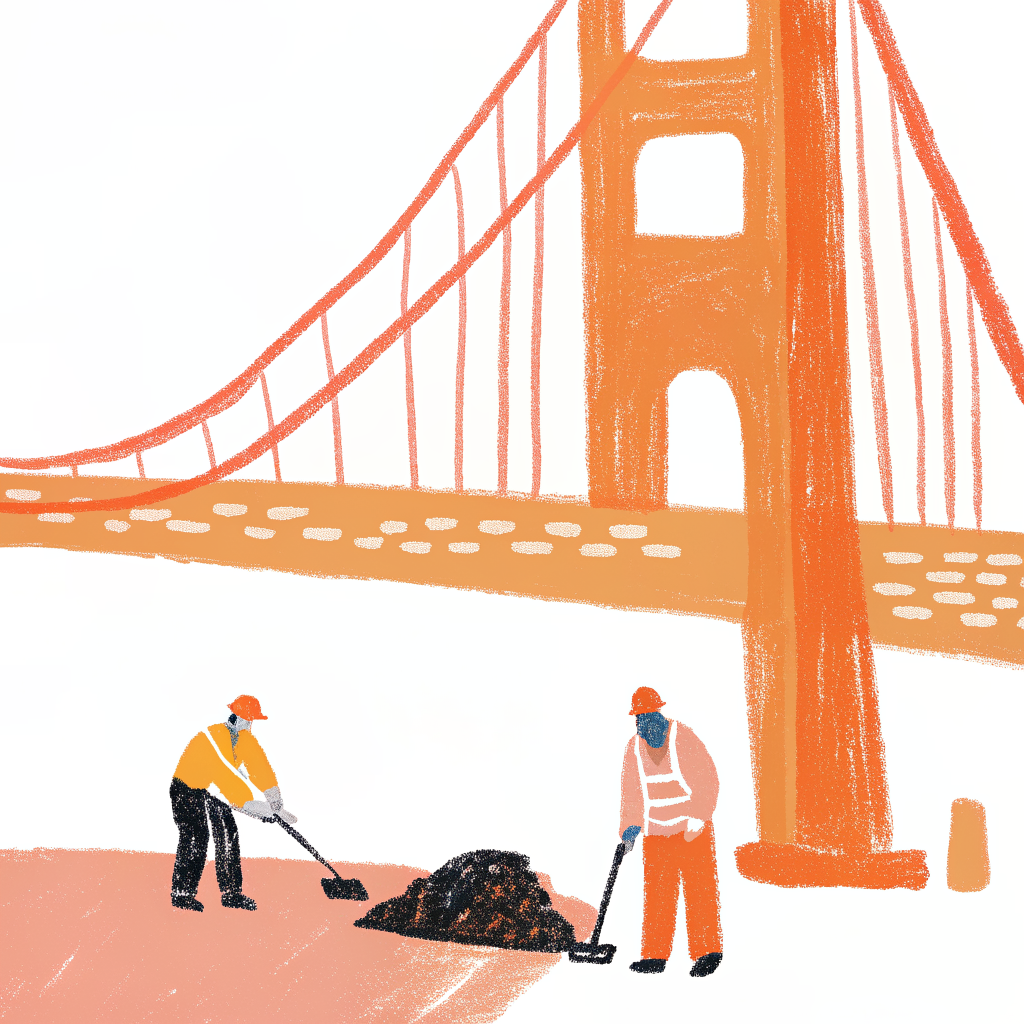
Crews will pull two of the Golden Gate Bridge's southbound lanes out of service for several midday hours on each of four weekdays next week to patch potholes and repave asphalt — a modest bit of maintenance that doubles as a preview of the disruption headed for the 88-year-old span.
The closures themselves are minor: the bridge district says two lanes will stay open in each direction the whole time, with the span restored to three-and-three by early afternoon. But the pothole work — set to repeat for four-day stretches in September, October and November — is the last easy chapter before the district begins the final, roughly $1.8 billion phase of a seismic retrofit that will reshape traffic on the crossing for more than a decade, on the books of an agency that survives almost entirely on tolls.
Drivers crossing the Golden Gate Bridge starting Monday should expect to slow for cones. For four consecutive weekdays, Aug. 17 through Aug. 20, the district will take two southbound lanes out of service for pothole and asphalt repairs, per its own public advisory. The lanes come down mid-morning, around 9:30, and are back in service by early afternoon; two lanes keep moving in each direction throughout, and the full three-and-three layout returns by 2 p.m. Three more four-day rounds are set for this fall, in the weeks of Sept. 7, Oct. 5 and Nov. 2, as the San Francisco Chronicle first reported.
Slotting the work into the lull between commutes is the district's usual way of limiting the damage. Weather and traffic will be assessed before each round, and the dates may move, Patch reported.
What makes a routine repaving worth a reader's attention is what follows it. The patching is explicitly separate from the seismic retrofit — but that far larger job is now imminent, and it will make next week's cones look quaint.
The district's board cleared the retrofit's final phase last October, authorizing roughly $1.01 billion in spending, the Marin Independent Journal reported. The centerpiece is an $864 million contract with Halmar International, a New York firm, alongside a $141.7 million reserve-funded budget bump. Officials describe this as "contract 1," slated to start in early 2026 and last six years; a second contract worth an estimated $900 million or so would carry the work another five years after that. Add it up and the bridge is looking at close to $1.8 billion in reinforcement and more than ten years of construction on a structure that first opened in 1937.
Board members framed the October award as a milestone — a long-awaited investment in a bridge they say must be able to survive the next major quake. Patricia Garbarino, who sits on the board representing Marin, cast it as securing the span for future generations; Marin County Supervisor Dennis Rodoni called the outlay a major, overdue commitment to North Bay infrastructure, according to the same account.
Officials describe this as "contract 1," slated to start in early 2026 and last six years; a second contract worth an estimated $900 million or so would carry the work another five years after that.
The cost has run well past early projections of about $880 million. District spokesperson Paolo Cosulich-Schwartz has tied that escalation to post-pandemic spikes in construction labor and materials prices, and said the agency remains committed to finishing the entire retrofit while it works out how to pay for the second contract in the coming years.
The money question is the quiet drama. Tolls are the district's main revenue, and it is unusual among transit agencies in getting no dedicated state or local tax support — by staff's own accounting, close to 80% of its capital dollars come from Washington. The first contract depends on that federal exposure: a Bridge Investment Program grant of $395.7 million does the heaviest lifting, topped up by roughly $274 million from district reserves and $200 million routed through Caltrans' federal bridge program. And those federal dollars carry political risk. The U.S. Department of Transportation sent the district a letter in April cautioning against diversity, equity and inclusion policies; over the summer, district officials stripped DEI language from policy documents rather than jeopardize a grant they said hung in the balance.
The retrofit traces to the 1989 Loma Prieta earthquake, which left the Golden Gate untouched even as it collapsed a section of the Bay Bridge and Oakland's Cypress viaduct 60 miles to the south. A subsequent district study concluded a magnitude-8.0 quake centered nearby could threaten collapse at the bridge's viaducts and the Fort Point Arch. Upgrades costing about $260 million between 2001 and 2014 took those sections off the collapse list; the final phase turns to the towers, side spans and main span, and includes 38 devices designed to absorb and dissipate seismic energy.
The aim, officials say, is a crossing that could reopen to emergency vehicles within a day and to everyone else within three after a major earthquake. That decade-long effort begins, in the smallest possible way, with next week's potholes.
Sources: Golden Gate Bridge District public advisory; San Francisco Chronicle (Rachel Swan); Patch San Francisco (Albert Gregory); Marin Independent Journal (Adrian Rodriguez). Direct links in the filing record below.
The Discussion
Sign in to join the discussion.
Loading…