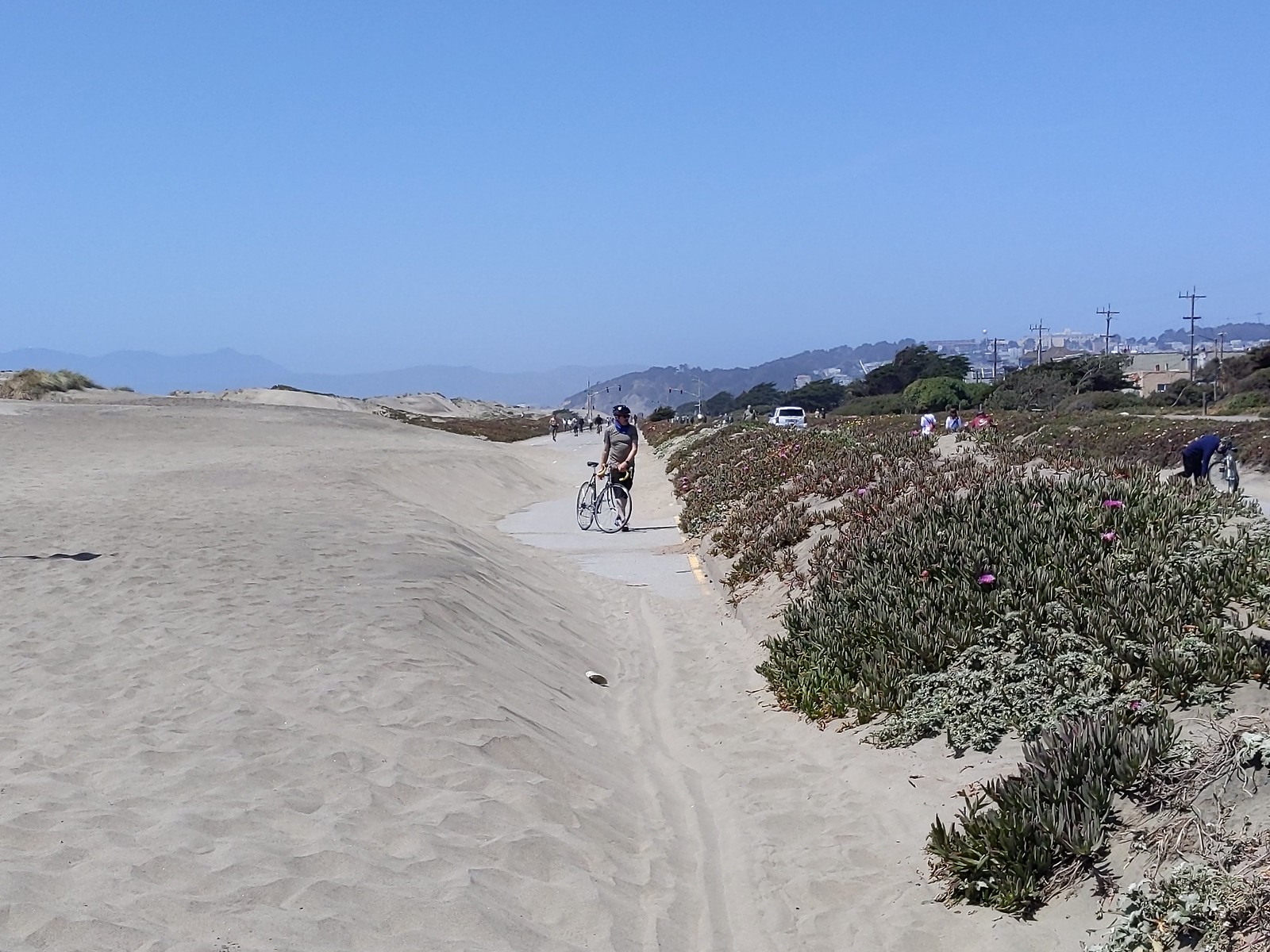
The nonprofit behind Sunset Dunes filed a lawsuit Friday to block what would be the fourth ballot attempt to reopen the Great Highway to weekday car traffic, alleging that the circulating petition contains multiple factual falsehoods — including misrepresentations about emergency vehicle access and Friday park hours.
The legal challenge arrives as the signature drive approaches a July 6 deadline, injecting fresh urgency into one of San Francisco's most exhausting political fights. Five years of litigation, a hotly contested ballot measure, and the recall of a district supervisor have not settled the fate of the coastal stretch. Now the park's supporters are arguing in court that opponents can't even accurately describe their own proposal.
The Friends of Sunset Dunes filed the suit in San Francisco Superior Court on June 26, naming the city's director of elections, John Arntz, as the defendant. Also named as parties are former SFPD commander Richard Corriea and the group Great Highway for Everyone — the coalition pressing to restore weekday vehicle access to the stretch of road that became a park under Proposition K, which voters approved 55 to 45 in November 2024.
The lawsuit alleges the petition being circulated for signatures is riddled with "false and misleading statements" that "unlawfully deprived" would-be signers of their right to understand what they were endorsing, according to Mission Local, which first reported on the suit. The group is asking the court to keep the measure off the November 3 ballot.
The Friday hours discrepancy
One of the lawsuit's central claims targets the petition's framing of what the new measure would actually do. The petition describes its approach as restoring a "balanced approach that was working effectively before Proposition K" — a reference to a prior compromise under which cars were cleared from the road beginning at noon on Fridays.
But the proposed measure would not replicate that arrangement, the suit argues. Under the new proposal, vehicles would retain access until 6 p.m. on Fridays — six additional hours of car access compared to the prior compromise.
"That removes all daylight hours of Friday afternoon. So people who work weekends or otherwise can't use the park on weekends wouldn't have really any meaningful access to the park under their measure," said Zach Lipton, a volunteer and board member of the Friends of Sunset Dunes nonprofit, speaking to Mission Local.
More than half of all visits to Sunset Dunes during its first year were on weekdays, according to the San Francisco Recreation and Park Department.
Second, it disputes the petition's characterization of the Upper Great Highway as "a critical coastal evacuation route" whose closure eliminated a lifeline in the event of an earthquake or wildfire.
Emergency access and evacuation claims
The lawsuit also challenges two safety-related claims embedded in the petition. First, it alleges the petition falsely asserts that Sunset Dunes slows emergency response times because vehicles must use alternate routes — when in fact emergency vehicles still have access to the park.
Second, it disputes the petition's characterization of the Upper Great Highway as "a critical coastal evacuation route" whose closure eliminated a lifeline in the event of an earthquake or wildfire. A 2024 letter from the San Francisco Department of Emergency Management directly contradicts that framing, stating that the highway "is not a designated emergency evacuation route and closing it to private vehicles will not change our existing emergency response protocols."
"Today's lawsuit goes beyond sort of the normal hyperbole of a political campaign. These are purely factual statements that voters deserve to have accurate information about," Lipton told Mission Local.
The road-to-park saga, continued
Sunset Dunes drew 1.7 million visitors in its first year of operation, according to Rec and Park — a figure backers have repeatedly marshaled to argue the park has public legitimacy that repeated legal and electoral challenges have failed to erode. The Friends of Sunset Dunes maintains a running list of what they call "Failed attempts to kill Sunset Dunes," now at 13 items.
This would be the fourth time Great Highway opponents have attempted to place the issue back before voters.
The City Attorney's Office offered a brief response. Spokesperson Jen Kwart said: "We will review the petition and respond in court." Corriea, reached by Mission Local, said only: "I have no comment."
Great Highway for Everyone must gather roughly 10,000 valid signatures before July 6 to qualify the measure for the November ballot. Even if the group clears that threshold and the court challenge fails, a second referendum would face a city electorate that has already said no — by a margin of 10 percentage points — to the exact question being relitigated.
Reporting based on Mission Local's coverage by Yujie Zhou.
The Discussion
Sign in to join the discussion.
Loading…