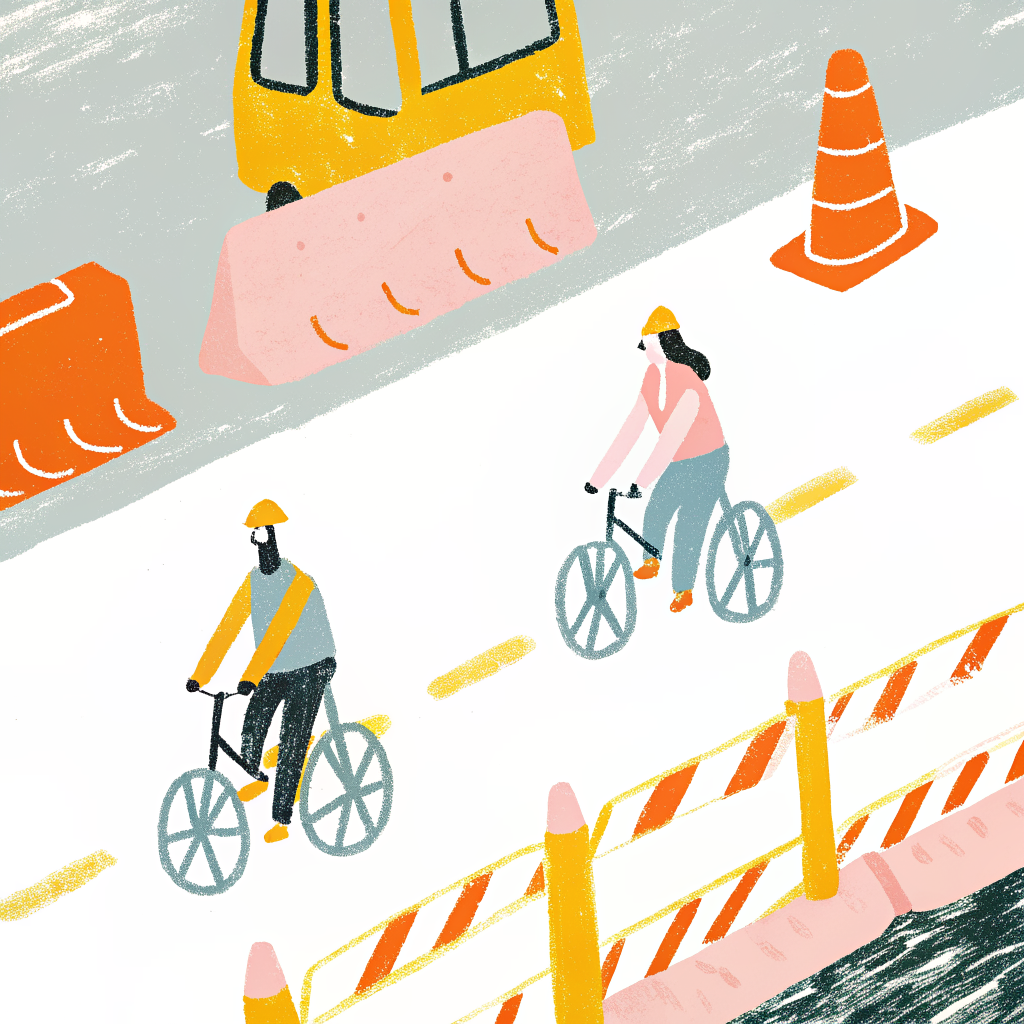
At the corner of Jackson and 5th in Oakland, Caltrans has bolted together concrete pedestals, a pole and Jersey barriers into exactly the kind of protected intersection safe-streets advocates have begged the agency to build for years. The catch, one of those advocates says: it was built to protect Caltrans' own construction workers, and it comes out when they leave.
In a commentary published August 6 in Streetsblog San Francisco, transportation writer Roger Rudick argues that the temporary safety barriers going up around the Oakland Alameda Access Project — a $175 million effort to reconfigure and widen freeway ramps off the Nimitz — expose a stark double standard: Caltrans knows how to make corners safe for people on foot and bike, and does so reflexively when its own staff are in harm's way, but treats the same protection for the public as optional. The charge lands awkwardly against the agency's own marketing for the project, which sells it as a safety and bike-and-pedestrian upgrade.
The Oakland Alameda Access Project (OAAP), formerly the I-880 Broadway–Jackson Project, is real and well documented. According to the Alameda County Transportation Commission — the project's sponsor — Caltrans now leads construction, in partnership with the cities of Oakland and Alameda and AC Transit. The commission's own project page frames the work as "a long-term investment in our community's safety, equity, and connectivity," promising "safe and accessible bicycle and pedestrian facilities" and "safety and accessibility improvements at intersections." It notes that Chinatown, which the ramps feed, accounts for more than 60 percent of Oakland's severe and fatal collisions.
That official framing is the backdrop for Rudick's on-the-ground account. He describes crews at Jackson and 5th and at Oak and 5th erecting concrete-and-barrier "protected corners" that force drivers exiting the freeway to slow down — a more robust version, he writes, of the granite-protected corners common in New York, London and European Vision Zero cities. His objection is not that the barriers exist. It is that, by his reporting, they are temporary staging protection for workers redoing gutters and sidewalks, and will be torn out once the wider ramps are finished — after which "reckless drivers will once again fly off the freeway and speed around the corners in the neighborhood with impunity."
Rudick's sharpest example concerns Oak Street. He writes that Caltrans removed painted bike lanes there and replaced them with sharrows — shared-lane markings that give cyclists no dedicated space — at the start of construction, and that advocates with Bike East Bay pushed back hard. The agency's response, he says, was to stripe a bike lane along the traffic-exposed side of its barriers, then use the reclaimed space to park construction trucks. The Dissent could not independently confirm the Oak Street lane change or Bike East Bay's specific objections; those details rest on Rudick's reporting and photographs.
There is one verifiable irony in the piece's own container: Streetsblog San Francisco's article carries a "Sponsored" banner thanking "our advertising sponsor — Caltrans." The outlet ran a blistering critique of the same agency underwriting the page.
Whether the protected corners are genuinely doomed is the open question the commentary raises but cannot settle. Alameda CTC's materials describe the OAAP as adding permanent bike and pedestrian facilities, including a new bikeway in the Webster Tube and intersection upgrades — not merely restoring a hostile status quo. The gap between that promise and what a longtime observer says he is watching get built and un-built at street level is the story worth chasing. It turns on a concrete question a reporter can put to Caltrans: which of the current safety features survive the widening, and which come out with the orange cones?
Caltrans District 4 did not have an on-record response to Rudick's specific allegations as of publication. Alameda CTC's project office directs current construction questions to Caltrans, whose OAAP updates are posted through the agency's District 4 channels.
The Discussion
Sign in to join the discussion.
Loading…