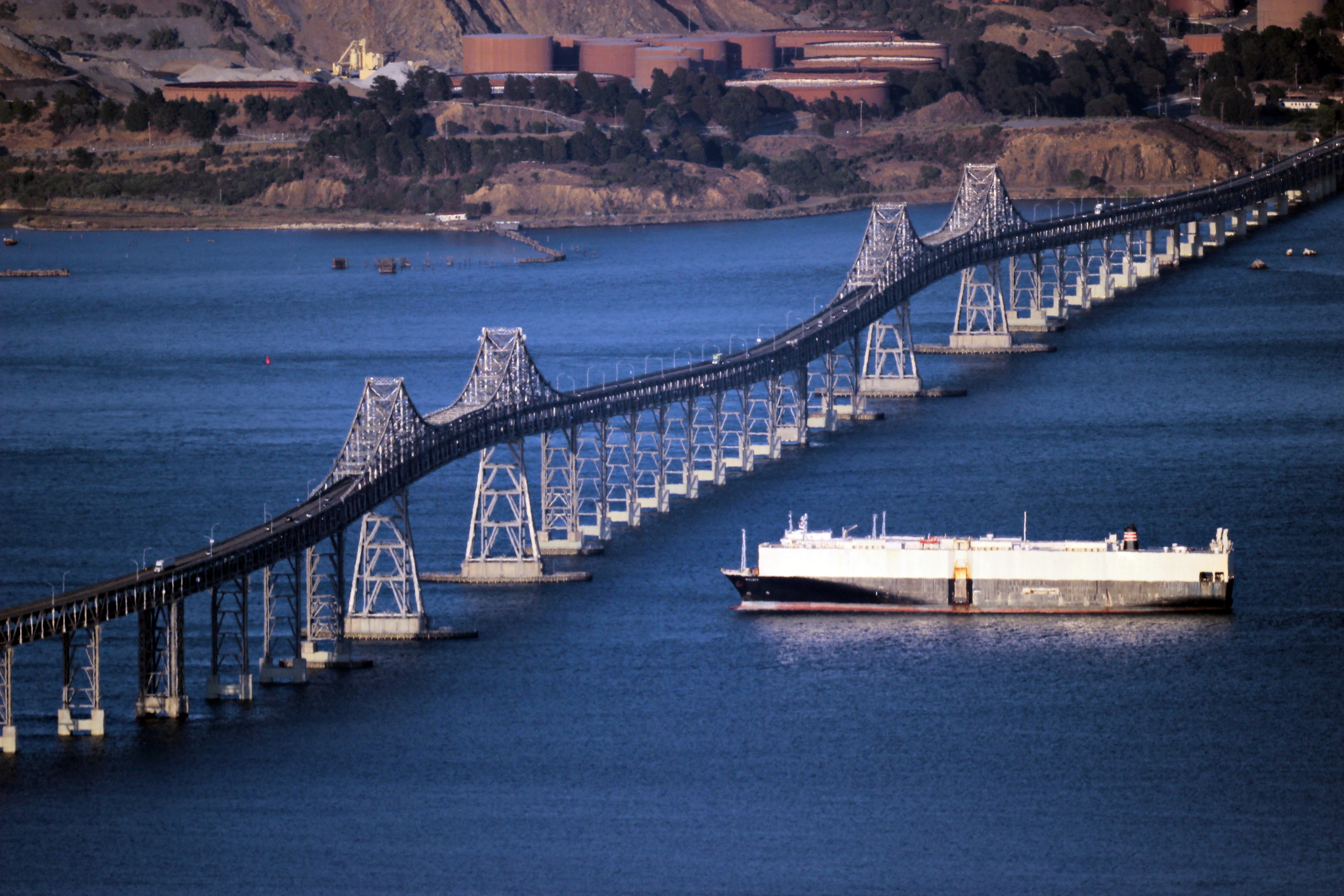
Here's a brain teaser for you: What do you get when a government agency removes a functional bike lane from the Richmond-San Rafael Bridge on weekdays?
If you guessed "more car capacity," congratulations — you think like a rational person. Unfortunately, you'd also be wrong.
Caltrans recently axed the weekday bike lane on the Richmond-San Rafael Bridge, theoretically to reclaim that rightmost lane for vehicle traffic. The problem? The lane isn't actually being used by cars. Commuters crossing the bridge report the right lane sits essentially empty — a ghost lane, if you will — while cyclists who previously had a legitimate cross-bay option are left with nothing.
Let that sink in. We didn't trade a bike lane for car capacity. We just… eliminated a transportation option and replaced it with air. It's the government equivalent of removing a perfectly functional water fountain because someone might want to put a vending machine there someday, and then never installing the vending machine.
One Bay Area commuter nailed it: "The right lane is the most underused lane in California. We might as well start building every on and off ramp into the left lane."
To be fair, there's a counterargument worth acknowledging. The lane does serve as an emergency breakdown lane — and on a narrow two-lane bridge with no shoulder, one disabled vehicle can gridlock the entire crossing. As one local pointed out, "A disabled vehicle on a 2-lane bridge with no turnout effectively shuts down the bridge." That's a legitimate safety concern, and Caltrans does run a free bike shuttle Monday through Thursday as an alternative.
But here's where the fiscal conservative in us starts twitching: we're spending money operating a shuttle service to replace a bike lane that cost virtually nothing to maintain, in order to keep open a breakdown lane that apparently nobody is using anyway. This is the kind of circular bureaucratic logic that makes taxpayers want to scream into the void.
The Richmond-San Rafael Bridge bike lane was a rare win — low-cost infrastructure that gave people an actual alternative to sitting in traffic. If Caltrans wants to keep that emergency lane, fine. But show us the data. How many breakdowns per month justify eliminating daily bike access? What's the shuttle costing us? Government accountability means proving the tradeoff is worth it — not just making decisions and hoping nobody notices.
As one local pointed out, "A disabled vehicle on a 2-lane bridge with no turnout effectively shuts down the bridge."
Right now, nobody's winning on that bridge. And that's the most Bay Area transportation outcome imaginable.
The Discussion
Sign in to join the discussion.
Loading…