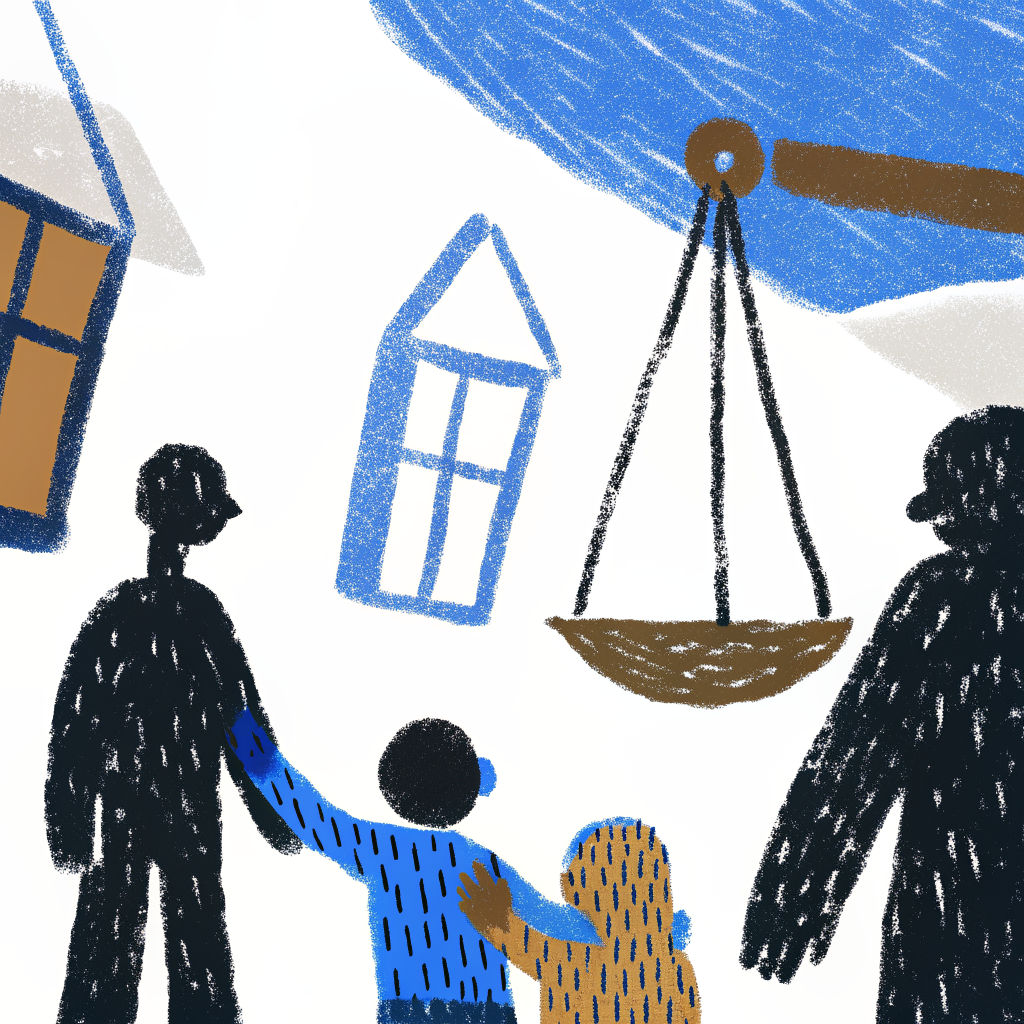
The court case now deciding whether tens of thousands of unaccompanied migrant children keep their government-funded lawyers carries the name of a small nonprofit on Bay Road in East Palo Alto — and on Aug. 6 its Oakland judge told the Trump administration to explain how it is obeying the law at all.
A modest legal-aid shop south of the Dumbarton Bridge, CLSEPA, is lead plaintiff in a Northern District of California suit that has repeatedly blocked the administration from cutting off funding for children's immigration lawyers. The fight turned local-to-national this month: after the legal-aid network's federal contract lapsed July 31, HHS handed a no-bid deal worth up to $244 million to a Utah anti-trafficking group with no track record representing children in court — while an Oakland federal judge, Araceli Martínez-Olguín, warned there was no working mechanism to guarantee the kids the counsel Congress already paid for.
Katrina Logan's team of lawyers and social workers in East Palo Alto is currently representing 33 unaccompanied children. Their federal contract ran out on July 31. They are not leaving.
Logan, who directs the nonprofit, told KQED (external source, opens in a new tab) her attorneys have spent years building the expertise this work demands, and losing the money is "definitely tough."
Her group's full name — Community Legal Services in East Palo Alto — sits atop the caption of the case now driving the national fight. It is lead plaintiff in CLSEPA v. HHS, No. 4:25-cv-02847, according to Bloomberg Law (external source, opens in a new tab). The suit blocked the agency last year when it moved to strip funding for lawyers representing more than 20,000 children nationwide, over 4,000 of them in California.
At issue was money frozen since December. The department had stopped paying once the nonprofits refused a new demand to surrender case details on the children — their alien registration numbers and their lawyers' litigation plans. The judge threw out that condition on Aug. 6, found the government in violation of her earlier order, and directed the agency to release the roughly $65 million it still owed. She grounded the ruling in the 2008 Trafficking Victims Protection Reauthorization Act, which obligates the government to ensure unaccompanied children "have counsel to represent them," and pointed out that Congress has funded the work through 2027.
Logan, who directs the nonprofit, told KQED her attorneys have spent years building the expertise this work demands, and losing the money is "definitely tough."
Her sharper finding was about the present. "It appears to the Court that no mechanism presently exists by which Defendants are complying with the preliminary injunction," she wrote, ordering the administration to spell out how it would keep the children represented.
Washington's answer arrived within a week, and it did little to calm the network. HHS on Aug. 7 awarded a no-bid contract — $158 million, expandable to $244 million — to Our Rescue, the Utah group once called Operation Underground Railroad, NPR reported (external source, opens in a new tab). It was founded by Tim Ballard, the activist behind Sound of Freedom who later faced sexual-exploitation allegations he denies; it is now led by Derek Benner, a former ICE and Homeland Security Investigations official. Its advertised specialty is helping police run trafficking stings — not arguing minors' cases in immigration court.
Michael Lukens, whose Amica Center for Immigrant Rights represented children under the old contract, told NPR the group is "highly problematic" and lacks any expertise in the work. The upshot, he said, is that kids get hurt — and to him "that seems to be the point."
The Office of Refugee Resettlement told NPR it is "committed to ensuring every" unaccompanied child "has legal representation," and said a different provider, a refugee-services group, would cover kids in federal custody through Dec. 31. About 24,000 children are classified as unaccompanied nationwide, though only roughly 1,800 are in government custody at any point.
The Bay Area network says it would have kept the cases — just not on the government's terms. Handing over "sensitive, confidential, privileged data" to renew the work, said Acacia Center for Justice spokesperson Bilal Askaryar, was a line the group refused to cross. Acacia holds the master contract for CLSEPA and about 100 other nonprofits.
The back payment, with interest, has since gone out, Askaryar said. What happens to children whose cases can stretch for years — and whose East Palo Alto lawyers are now working without a contract — is the question the court is still waiting for the government to answer.
The Discussion
Sign in to join the discussion.
Loading…