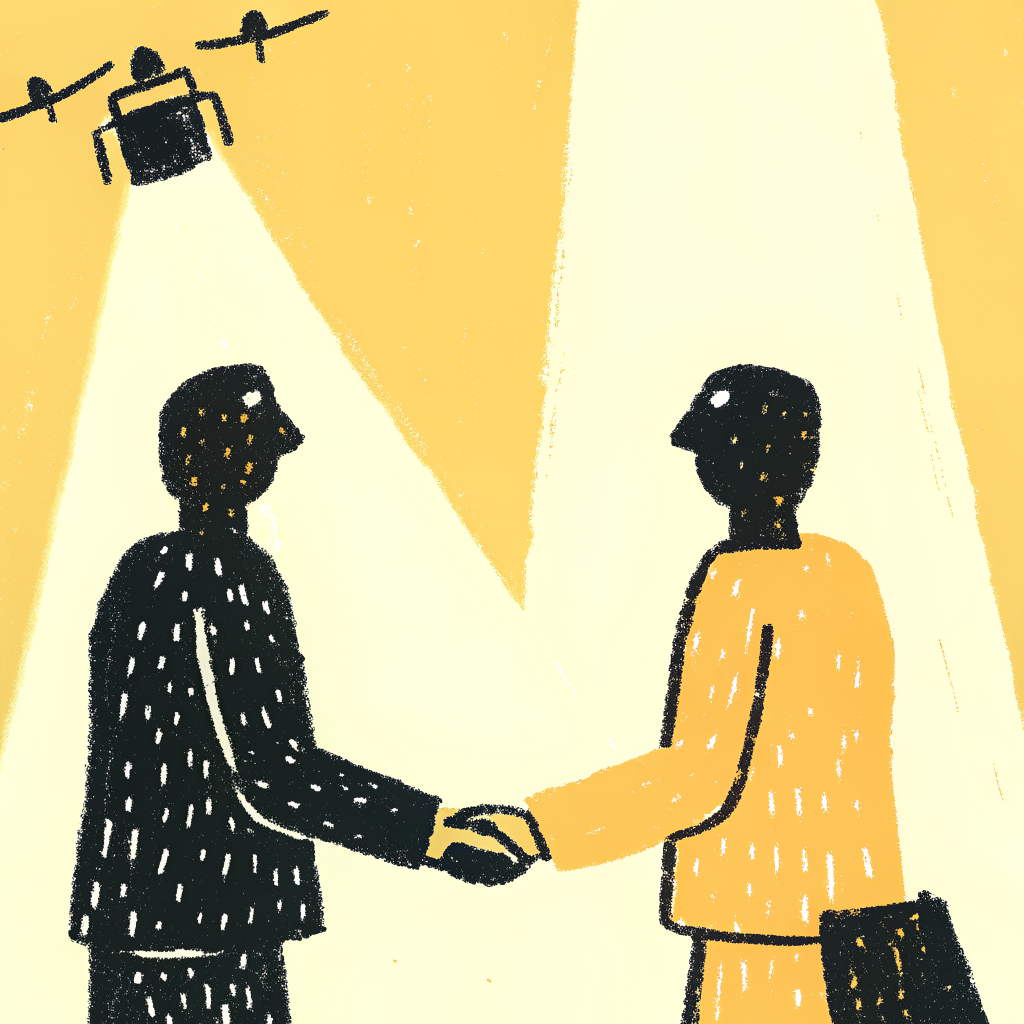
San Francisco prosecutors charged a man with dealing narcotics based on police drone footage of what officers called a hand-to-hand drug sale on Powell Street. His attorney watched the same video and saw a handshake. After four days in jail, the case was dismissed.
The dismissal, first reported by Mission Local, is the first publicly documented case in which a charge built on the San Francisco Police Department's drone surveillance collapsed because the footage did not show what officers said it showed. It lands squarely inside an oversight vacuum The Dissent has been tracking for months: a Real Time Investigations Center funded by tech billionaires, a drone program voters freed from Police Commission approval, and a surveillance regime the department has exempted from the city's own transparency ordinance. The handshake is not just an error — it is a stress test of a system built to move fast and answer to almost no one.
Defense attorney Will Helvestine hit "play" on the drone footage tracking his client through downtown and, as he told Mission Local (external source, opens in a new tab), did not see the narcotics transaction officers had described. He saw two men clasp hands on Powell Street on March 6, 2025, and walk off. In the days that followed, Helvestine said, he chased down the prosecutor in court and pressed him to rewatch the video, convinced it did not capture what the officers claimed.
The District Attorney's office moved to dismiss ahead of the preliminary hearing. San Francisco Superior Court Judge Michelle Tong granted the motion on May 8, 2025, according to court records reviewed by Mission Local. The DA's office said in a statement that it took a closer look at the video and concluded it could not proceed. That was a sharp reversal from the arresting officers, who — according to Mission Local's account of the incident report — had written that the defendant was carrying drugs and had been seen completing several street sales by hand. The office declined to explain the contradiction. Helvestine's client, who had no prior charges at the time, had already spent four days in jail.
The DA defended the broader program, calling drones a game changer and casting the dismissal as evidence the system corrects itself when a defense lawyer forces a second look. A department spokesperson, Evan Sernoffsky, would not discuss the specific arrest, but maintained that SFPD flies drones only during active investigations, never to hunt for crime.
The case is a single data point, but it lands inside a structure The Dissent has documented from several angles — and the structure is what makes it more than one bad arrest.
The oversight was voted away. In March 2024, San Francisco voters approved Proposition E, London Breed's public-safety measure, by roughly 60 percent. Prop E expanded police authority (external source, opens in a new tab) to deploy drones and surveillance cameras without sign-off from the Police Commission or the Board of Supervisors, shifting that approval to the police chief. The Real Time Investigations Center, which flies the drones alongside Flock automatic license-plate readers, expanded in the year that followed.
The transparency rules don't apply. As The Dissent reported in July, SFPD's drone operations are now explicitly exempt from the city's Surveillance Technology Ordinance — the mechanism that would otherwise force a public accounting of how the footage is used and how often it is wrong.
The money is private. The RTIC has been built up by benefactors including Ripple co-founder Chris Larsen, Reddit CEO Steve Huffman, and Michael Moritz's Crankstart foundation — a command center underwritten by billionaires and, increasingly, outside the ordinary budget-oversight loop.
The department's headline metric — more than 500 arrests aided by the RTIC last year — invites the question the dismissal raises: how many of those rest on a drone operator's read of a blurry aerial feed? Mission Local reported that the DA's office did not respond to its request for the numbers behind its claim that drones yield solid prosecutorial evidence.
Deputy Public Defender Brian Cox, who runs the office's Integrity Unit, told Mission Local that officers routinely read ordinary street interactions as drug deals, and that surveillance technology only widens their reach to do it. Saira Hussain, a senior staff attorney at the Electronic Frontier Foundation, told the outlet the case is worrying against a wider pattern of officers misusing high-tech crime tools like Flock.
One handshake got a second look because a defense attorney demanded the tape. The unanswered question is how many never do.
The Discussion
Sign in to join the discussion.
Loading…